Tue, 11 Dec 2012 00:19:45 GMT
- Cantor's Attic - if it just isn't big enough.
- Petition to begin construction of a Death Star by 2016 - ftw!
Deutsch:
- Kommt eine neue Abmahn-Welle auf uns zu? - Digitale Steinzeit!
- 19 Jungen aus Kinderpornoring befreit - es gibt also noch Polizisten, die wirklich Kinder retten, statt sie zu schlagen, nackt zu machen, sexuell zu nötigen, zu befummeln, in ihre intime Entwicklung einzugreifen, Comicbesitzer zu jagen, oder Politiker zu diffamieren - in Spanien jedenfalls. Respekt dafür.
- Infrastruktur - "Es gibt keine Konkurrenz, es gibt keine Vergleichbarkeit in den Angeboten, es gibt keine Möglichkeit eine nicht erhaltene Leistung einzuklagen".
- Die fairste PC-Mouse der Welt - ich kann mir nicht helfen, sie sieht einfach wie Hitler aus.
- Video: Sehr schlechter Sketch von Oliver Kalkofe - aber was will man ihm vorwerfen? Fernsehen ist einfach nicht mehr parodierbar.
- Können fehlende Deutschkenntnisse über Leben und Tod entscheiden? (via)
Comics and Images:
Sun, 09 Dec 2012 19:45:14 GMT
Sat, 08 Dec 2012 22:48:03 GMT
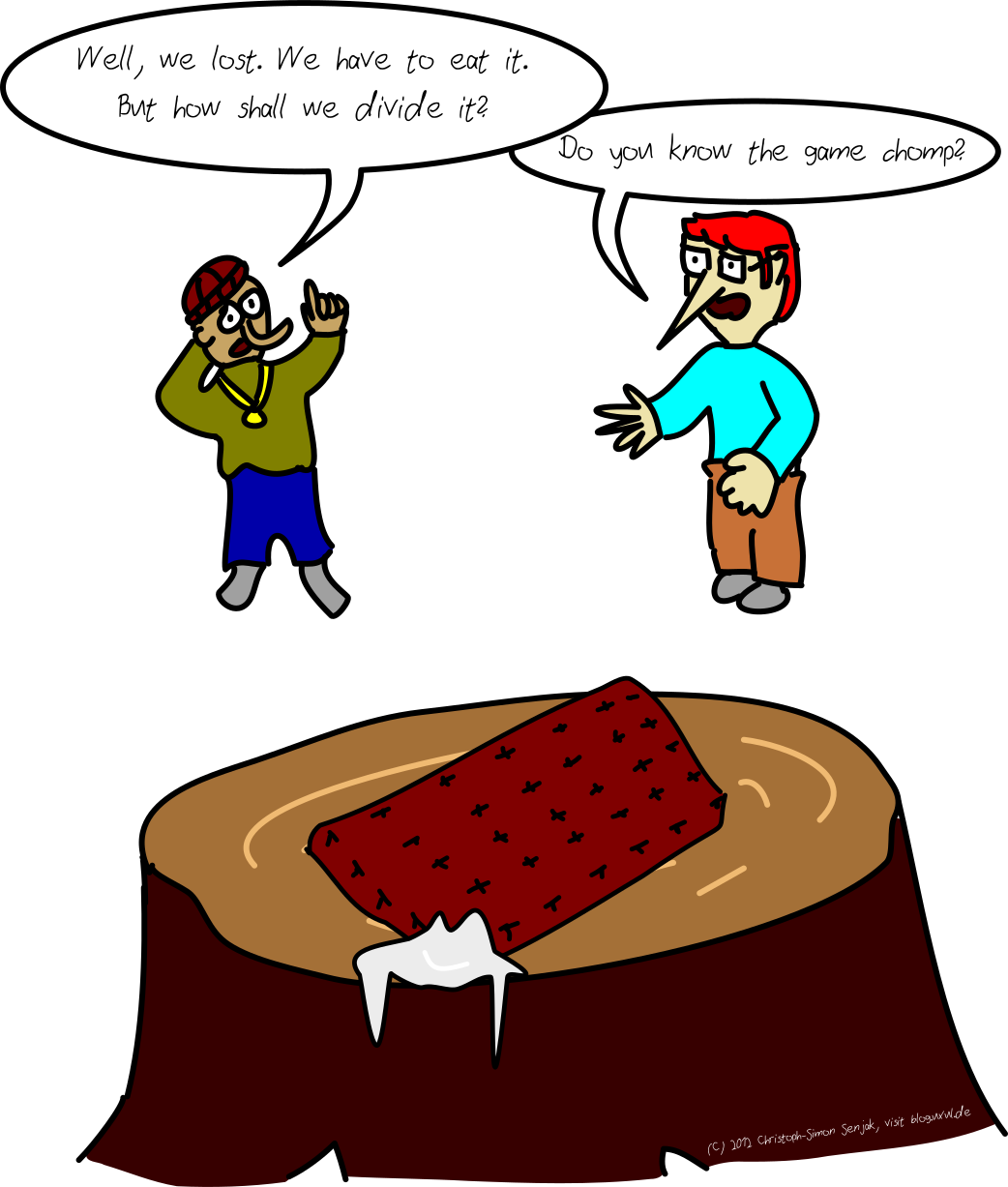
I will use some results from Transfinite Chomp by S. Huddleston and J. Shurman which I found on this excellent post from Xor's hammer.
Also keep in mind this is not a scientific paper, I will not always put footnotes everywhere I use information from the named paper. Especially, I change the notation so it will (hopefully) be compatible with ZFC (that is, there is no set of ordinal Numbers, etc.), as I think I have seen proofs in that paper that are not correct because of this (but I might be mistaken).
1 Finite Chomp
Before understanding ordinal chomp, it is useful to know finite chomp, and what makes it so interesting. We will try to give a definition that is less "economic" than the usual ones, but much more compatible with the intuition of a chocolate bar, which is the usual metaphor for explaining chomp.
Keep in mind that these definitions are preliminary and will later be generalized.
Definition: As a slight abuse of notation, we identify every integer with the set of its preceding numbers. So
Definition: A
Lemma: Every sequence of legal moves is finite.
Proof: Trivially, the number of preimages of
Definition: Let
- every branch of the tree ends in the final chocolate bar (that is, every branch is a whole game)
- the final chocolate bar in every branch is a player
chocolate bar (that is, player
- every player
node in the subtree is adjacent to all the player n chocolate bars that are adjacent in the original tree (that is, the winning of player n does not depend on the choices of player
We distinguish between weak and strong existence and disjunction. Usually, this is done to get a finer distinction between constructive and non-constructive propositions. However, we do not want to get too deep into that topic. So we give an informal definition.
Informal Definition: The weak disjunction between two propositions
and
is a disjunction which we proved without giving a possibility of deciding which one of these actually holds inside the proof. Strong disjunction
always comes with a theoretical possibility of decision directly inside the proof. The weak existence
holds if only the existence of an object is proved, but there is no way of calculating it giving imlicitly with the proof. With strong existence
comes such a way.
The distinction between those two kinds of existence and disjunction can be seen as one main difference between constructive and classical mathematics. While in constructive theories, one can set , in non-constructive mathematics, this is equivalent to usual disjunction.
Lemma: For every
Proof: Player 1 has to use
Lemma: For every chocolate bar
Proof: Note first that the "or" is exclusive here: Assume both existed, then consider a strategy for player 1. It will have some edge from
On the other hand, assume there is no strategy for player 1 or player 2. Then there must be some move player 1 can make, such that player 2 still has no winning strategy after this move. Player 2 can answer with a move after which player 1 again has no winning strategy, and so on. This is a contradiction, as every game has finite length.
Theorem: For every
Proof: Assume player 2 had a strategy
So we have an explicit winning strategy for finite quadratic chocolate bars. Unfortunately, even though we know we can always win, we have no winning strategy except bruteforcing for the rest of the cases (except for some additional special cases like our above Lemma).
Short introduction to ordinal numbers
Definition: A (strict) well-ordering is a (strict) total ordering in which every set has a minimum. A transitive set is a set of which every element is also a subset. An ordinal (number) is a transitive set which is strictly well-ordered by the
Here are some facts about ordinals which I will not prove:
- The above notation
is consistent with them.
- Every well-ordering on a set is isomorphic to some unique ordinal.
- Every decreasing sequence of ordinals is finite.
- The collection of ordinals
forms a proper class. It is not a set.
- Every ordinal
has a successor
.
- Some ordinals also have a predecessor. If
has no predecessor, we say that
is a limit ordinal, writing
.
- The smallest limit ordinal is called
, it is the set of finite (natural) numbers.
Definition: A cardinal is an ordinal which satisfies
.
We will only need cardinals in one small argument, in which we just need some "upper bound" for stuff we want to do.
A transfinite chocolate bar is defined similarily to the finite ones: An
We first prove a few generalizations for properties of finite chomp.
Lemma: The sequence
Proof: By definition of the application and
Theorem: Every sequence
Proof: By the Lemma, we know that the sequences
Lemma: For every chocolate bar
Proof: The above proof only requires every game to be of finite length, so it also applies here.
Lemma: Player 1 has a winning strategy for
Proof: The strategy is the same as for the finite case, but we have no parity here. However, it is easy to see that after every player 2 move, player 1 recovers a quadratic state, from which he has a winning move again.
Theorem: If
Proof: The argument is exactly the same as for the finite case.
One interesting part about transfinite chomp is that in some cases it is possible that the second player has a winning strategy.
Theorem: Let
Proof: Firstly we show uniqueness. Assuming the existence of
- For
, we use induction on
. If
,
,
. Otherwise, we assume that for all legal chocolate bars
with
, there already exists a
with the property. Especially then, for all legal chocolate bars
that can be reached from
by one move, there exist
. Then
is the solution: Trivially, every move player 1 makes leads to a state which player 2 can now win. Notice that if
was our previous cardinal,
is sufficient for everything we do (I am too lazy now to reason why
should be sufficient).
- For every other
, we may assume that for every pair of
and a legal chocolate bar
some
already exists. Let
be the
to the power of the supremum of all previous cardinals. Furthermore, for every legal chocolate bar
for some
by a move
with
, we also already have a
. Then the
of all these exists (since the cardinality is bounded), and its own cardinality is bounded, and it trivially satisfies what we want.
Proof: For
Fri, 07 Dec 2012 23:00:07 GMT
The first right you usually get is to vote. What would Common Lisp vote? Politics is complicated, and there is so much to choose, while Common Lisp does not like choosing, rather supporting everything. Not sure what it would vote. It is probably compatible with everything.
Furthermore, at that age you will be sui juris. You can do everything, but you are also responsible for everything you do. Common Lisp has its own ways of dealing with things, some of them are still unique, and many of them were unique for a long time. Meanwhile, there evolved other, younger languages like Ruby with similar concepts, which are more widespread. Common Lisp pays the prize of being beyond its time, at a time when Windows 95 was new.
Also, the society's duty for your protection rapidly decreases. Not only are you responsible for everything you do, but also, there are less people willing to encourage you in continuing to find yourself - you have had enough time for that. The people begin to demand you to actually achieve valuable things, that is, either things that are economically or socially valuable, or things that show that you will become economically or socially valuable. I think that Common Lisp has done this already: It provided expierience with concepts that combined academical and practical principles of programming. Maybe its glorious days are gone, but it is still an interesting language to use and to learn from.
In Germany, you have to pay fees every quarter of a year you go to a doctor. That is, when you have a medical problem, you lose additional money. Well, it seems like Common Lisp does not really use any health insurance anyway. There are several little diseases Common Lisp has, but for which there was never enough money to heal them. I am afraid that there is and will not be enough money to heal these diseases. But hopefully, the usual practices and implementations will have a self-healing effect.
Also, you can have a drivers' license when you are 18. I am not sure how successful Common Lisp is at driving cars. But as far as I heard, it has lost much of its importance for AI and robotics. I am not sure whether Common Lisp will ever drive a car. But if so, it would be awesome!
Mon, 03 Dec 2012 23:09:57 GMT
- "winning the creation vs. evolution war" - for fundamentalists everything is a war.
- GNU Guix - interessant, muss ich mal ausprobieren, scheint ja vieles zu machen was ich mir schon länger wünsche.
- NSFW: If Autocorrect Existed Throughout History
- Without Mushrooms
- Convert
- Baby gift
- The world after 21 December

Fri, 30 Nov 2012 23:55:11 GMT
Wed, 28 Nov 2012 04:39:49 GMT
The really big topic was definitely the internet, and the many new gadgets that evolved. So much seems to have changed. While back in my day™ - which is not that long ago yet - the greatest technical threat for the teachers' precious blabber were alarms of digital watches, it seems to be considered normal today that pupils are using their laptops, tablets and smartphones.
However, while the prognosis about the big topic turned out to be wrong, many prognoses about the internet did not. One of my teachers compared the weird situation of everybody being able to publish everything and the difficulties of checking it to the "Wild West", which may be regulated someday. Another one claimed that education will focus more on teaching how to get information required for some task, rather than building a huge collection of knowledge. Wikipedia puts lots of efforts into the quality of its source material, and people learned to distinguish between claims and quotes (which is, for example, a claim, since I have no evidence for this).
But since then, journalists are also questioned more, because people learned that not everything a journalist sais must be correct, journalists are no longer the masters of information anymore, and this takes a lot of possibilities for regulation away from the state.
And now, we have Anonymous, we have DuckDuckGo advertising for VanishingRights.com, we have an Internet Defense League, we have projects like Tor and Freenet, and even Google requests "Verteidige dein Netz" (defend your net).
Maybe in 50 years the people will wonder whether we had no other problems. Or they will look back and wish to have lived in that glorious time. We cannot know what actually happens. The internet is different to what people imagined 20 years ago, there is much more chaos than one would have expected. On the other hand, there are much more possibilities than one would have expected, like people with smartphones who are online virtually always, and cheap real-time-communication to huge parts of the world with only a little gadget.
One may argue that the internet on the whole is a bad thing. However, it is there, and it will probably stay there, and it has already influenced most of us somehow. We have something new with which we have no experience. These times are weird.
Tue, 27 Nov 2012 00:41:52 GMT
- A Complete Understanding is No Longer Possible - maybe it is time for something new and simple?
- Potato Scrubbing Gloves - most useful tool ever.
Deutsch:
- Zeitlupenkamera macht Ausbreitung von Licht sichtbar - leider ist der Titel etwas irreführend, ist aber trotzdem nett.
- Kritik am „Neuen Atheismus“ Richard Dawkins’ aus der Sicht Ludwig Feuerbachs (via) - endlich beginnen auch die Atheisten sich gegen ihre Fundi-Gruppen zu wehren.
- Die MDU stellt sich vor - hey, genau das was wir brauchen, noch eine konservative Partei. Das "Programm" ist recht kurz, beschränkt sich auf gutklingendes Standardblabla und ein bisschen "ich will aber auch!" für den Islam.
- Songtext der Wise Guys schockiert Schüler - "Einige seien so perplex gewesen, dass sie unter Tränen die Prüfung verlassen mussten."
- Warnung vor Proxtube - wie wär's mal damit, ein Tor-Netzwerk speziell für YouTube einzurichten?
Comics and Images:
Sat, 24 Nov 2012 23:03:16 GMT
Tue, 20 Nov 2012 02:22:18 GMT
- Leaning to the Left Makes the Eiffel Tower Seem Smaller (via)
- Markdown may be defined as a standard - which probably means that soon there will be semantic rdf-extensions and an XML-based format for embedding scripts and media into it.
- Some SIMD extensions in GCC - could be useful.
- Screw-in coffin - still better than an overpriced crate.
- LTFS Specification - finally, a filesystem using XML metadata!
- Video: DIY Hologram generator 3D - well, not quite 3d, but still nice, simple to build, and maybe useful somehow.
- NSFW: Natural Harvest — A Collection of *****-Based Recipes - いただきます
- Video, NSFW: The Day The Earth Stopped ************
Deutsch:
- Stoppt den Verkauf von Stopfleber in Deutschland!
- Mozilla entwickelt freie Flash-Laufzeitumgebung - die wird bestimmt mindestens so erfolgreich wie die anderen.
- Cannabisprohibition: Der Anfang vom Ende (via) - wird auch Zeit.
- Interview mit Gründer Gabriel Weinberg über DuckDuckGo - ich nutze ja DuckDuckGo wo immer es geht, aber oft liefert Google einfach die besseren Ergebnisse, ich hoffe, dass sich das noch ändert.
Comics and Images: