Sun, 13 Nov 2011 23:44:58 GMT

Show comments (Requires JavaScript, loads external content and cookies from Disqus.com)
Fri, 04 Nov 2011 12:04:06 GMT
I already wrote about a campaign "Vergoogeln Sie keine Zeit" (do not waste your time with google) in my university's library. I usually try not to use it, but today, I was looking for a book to learn for my current tests, about algebraic curves.
Firstly, I tried to survive without technology, and went to the shelves for the topic of algebraic geometry. Since I did not find the book there, I searched with their local web interface. The main problem was probably that I misspelled the actual author, I searched for "Fulten" rather than "Fulton", but every reasonable search mechanism should be able to find the right book with a perfectly correct title given, and a little mistake on the author's name. However, of course I tried to search only for "Fulten" and only for "Algebraic Curves", the latter query returned a long list of highly specialized stuff related to algebraic curves, but not the desired book (at least not at the first three pages of at least 20).
As I did not want to waste any more time with this, I searched with Google for "Fulten Algebraic Curves". It suggested "Fulton Algebraic Curves", and using this suggestion, the first Item I found was the site of William Fulton, publishing his book as a free PDF.
I rest my case.
Tue, 01 Nov 2011 04:01:24 GMT
Fri, 28 Oct 2011 22:44:23 GMT
(Sorry for this one)
Wed, 12 Oct 2011 21:39:00 GMT
So, finally, this is part 4 of my series about the irrefutability of the AC from ZF. We are almost there!
Theorem 1: Let ZF-Formulae be given. Then
  . We then say that
  reflects the
  .
.
Proof: Let be given. Without loss of generality we may assume that the can be written without universal quantifiers, as we can replace every universal quantifier by a negated existential quantifier of the negated quantfied formula.
Recursively define a sequence where
where  and
and  is the smallest ordinal
  , such that if
  is a subformula of one of the , we have
  . Let
. Let  be the supremum of the
  . It is sufficient to show that for all subformulae
  of any we have
  , which goes by structural induction. If
  is of the form
  this is trivial. The step over
  is clear. We can assume that every occurence of
  is in the scope of an occurence of
  , and therefore, instead of having an induction step for , we have an induction step for :
  , and let
  . By induction hypothesis,
  . For the other direction, let , then
  . By induction hypothesis, we have
  .
.
 , let
, let  be its embedding into ZF, that is, is a set.
For every set we can define an interpretation, interpreting
  by
by  . We write
  if this interpretation (for all valuations) models , notice that in this case,
  is a relation inside ZF. Trivially, we have
  .
.
Definition: Now we can define the class of of ordinal definable sets:

where we write to denote that there must exist an encoded ZF-formula.
This class is interesting, as it messes around with the intuition about two meta-layers. However, it is not yet our goal.
Definition: The transitive closure of a set
  is the smallest
  such that every element of
  is also subset of .
Definition: The class of hereditary ordinal definable sets is defined by

Since , trivially
  .
.
Lemma 1: .
.
Proof: "=>": From directly follows
  , therefore,
  . For
. For  we have
  , that is,
  , therefore,
  .
.
"<=": For and  we have
  . Therefore, .
 we have
  .
.
Proof: Let , such that
  , and
, and  . By Theorem 1 there is a
  such that reflects , therefore
  .
.
is an inner model.
Proof: Due to Part 3, it is sufficient to show (I1), (I2) and (I3). By Lemma 1, (I1) holds.
Let, and such that  . Then trivially,
  . But by Lemma 2 we have
  . Trivially, we also have
  , so by Lemma 1,
  . Thus, (I2) holds.
For (I3), let be a
be a  -formula, choose arbitrary
  , and let
  . Then
  by (I1), so by Lemma 1, it is sufficient to show that
  . As we have
  , therefore there are
  and
and  and for
  there are
  ,
,  sucht hat
  and
and  . Let
. Let  , and
, and  . By Theorem 1 we get a
  such that reflects
  . Therefore

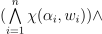

which is in. Therefore,  .
.
 .
.
Proof: In Part 2 we proved that there is a bijection , so it is sufficient to give a surjective functor
  . Now let
  be an enumeration of all ZF-formulae. Define

Then is surjective.

Proof: Since, use  .
.
Proof: By Lemma 4, we have our surjective. For  , define
  . By Lemma 2 we know that for every ,
  , and since
  , we have
  . Let
. Let  be arbitrary but fixed. Then there exists an such that
  . Now define a well-ordering
  by
by

 is a well-ordering, and
  . Thus, in , the well-ordering theorem holds, therefore, AC holds in .
Theorem 1: Let ZF-Formulae
Proof: Let
Recursively define a sequence
□
We can do everything we did in Part 1 as well directly in ZF. Alphabets become sets, and formulae become finite sequences. Especially, there is a set of all formulae, which is countable. Notice that there is no need to fix a special "encoding" for formulae, it is clear that one exists, and it is clear that all such encodings have to be equivalent. For a ZF-formula For every set
Definition: Now we can define the class of
where we write
This class is interesting, as it messes around with the intuition about two meta-layers. However, it is not yet our goal.
Definition: The transitive closure
Definition: The class
Since
Lemma 1:
Proof: "=>": From
"<=": For
□
Lemma 2: For every ZF-formula Proof: Let
□
Theorem 2: Proof: Due to Part 3, it is sufficient to show (I1), (I2) and (I3). By Lemma 1, (I1) holds.
Let
For (I3), let
which is in
□
Lemma 3: There exists a surjective functor Proof: In Part 2 we proved that there is a bijection
Then
□
Lemma 4: There exists a surjective functor Proof: Since
□
Theorem: (AC) holds in Proof: By Lemma 4, we have our surjective
□
Sun, 09 Oct 2011 20:15:00 GMT
This is part 3 of my posts about the irrefutability of AC in ZF.
We define a hierarchy of sets, the -hierarchy.
 for
for
 , which can be shown by a trivial
inductive argument.
, which can be shown by a trivial
inductive argument.
Theorem: We have .
.
Proof: Assume there was an which is not in
  for some . Then it cannot be subset of any , since otherwise it would be element of
  . Therefore it must contain an element
  which is not in for every as well. That is, every set not being in any of the must contain a set not being in any of the , hence, we would get an infinite
  -chain, which contradicts (FUN). □
Definition: The relativization of a formula regarding a class
  is defined inductively over the structure on by:
means that holds in . We will later write  to denote that holds, defining yet another additional meaning for .
Definition: A class is called inner model of ZF, if it satisfies
is an inner model of ZF, since  .
.
Inner models provide a way of getting new models from models of ZF:
Remark: Let be an inner model of ZF, and  be a model of ZF with domain
  and the -relation interpreted by a relation
  . Let
. Let  and
and  be an interpretation with domain
  and -relation
  . Then
  .
.
Therefore, it is sufficient to give an inner model of ZF satisfying AC to show that AC is not refutable: From a model of ZF, we would get a model of ZF satisfying AC. That is what we are going to do. Before we can do this, we have to do some work to give an alternative classification of inner models.
Definition: A formula is called-formula, if every quantifier is bounded, that is, every universal quantifier is of the form  , and equivalently, every existential quantifier is of the form
  . (Recall that our language does not contain existential quantifiers directly, but defines them by universal quantifiers. However, our definition is equivalent to what we would get directly.)
Notice that is a -formula.
We write for , and
  for
for  . Furthermore, if we want to denote a list of variables, then we use the vector notation
  , and we will use
  to denote the universal quantification over all of these variables.
Theorem I: Let be a class. Then the following propositions are equivalent:
-comprehension: For every -formula we have  .
.
Limitation: For every ZF-formula we have
Theorem: These schemes are derivable from ZF.
Proof:-comprehension follows by general comprehension, which follows by (RPL). For limitation, let ,  and be given, and
  . Define a function
  ; this is well-defined, since such a
  always exists according to the above theorem. Then the range of
  is a set of ordinals, and therefore has a supremum . Now set
  . Then
  contains an for every , such that .
We now show the converse, these schemes imply replacement.
Lemma: For every ZF-formula ,
,  can be shown by -comprehension and limitation, not using full comprehension.
Proof: Recall that for pairs . We show that from
  follows
  :
:  ,
,  are sets by -comprehension. By limitation, there exists a set
  such that for all
  we have an
  with
with  . That is, contains a superset of
  for every , that is
  is a superset of
  , thus,
  is a set due to -comprehension.
We now use structural induction on.
If , then
  is the desired set.
If is of the form  , let
, let  be given and let
 , and
, and  is a -formula, which means that is a set by -comprehension.
If is of the form  , then

 and these are both sets by induction.
For notice that
  , therefore it is sufficient to show the induction step for negations. Thus, let
  . Then
  which is a set by induction.
For , by limitation we have a set
  with
with  . By induction hypothesis,
  , and therefore
 . Therefore, by -comprehension,
 , therefore,
  .
.
-formulae and classes such that  follows
  .
.
Proof: By structural induction. For everything except quantors, the relativization can be looped through. For quantors, we may assume that we always have an existential quantifier, since . So let
  . We may assume that
  , since otherwise the formula would be equivalent to
  . Let
. Let  , then by induction hypothesis
  , and therefore
  . For the other direction, assume
  , that is, there is some
  such that
  . Then
  implies
  which implies
  , so by induction hypothesis,
  , and since we have
  , therefore
  .
.
-formulae  and classes in which every element is a subset we have
  and
and 
Theorem: From-comprehension and limitation follows replacement.
Proof: Let be a functor, and  . By limitation we get a with
  . Then
  by the above Lemma.
We finally arrive at...
Proof of Theorem I: "a=>b": (I1) by definition. For (I2), consider the-hierarchy inside , that is, define  . For
. For  we can find an such t hat
  , and
, and  . For (I3), let be a -formula and let
  . Because of (I1) we have
  for all
  according to the above lemma. Therefore, for every
  ,
,  , which is in by comprehension.
"b=>a": Trivially, is transitive, and as every transitive set of ordinals is an ordinal, either
  or
or  . Assume , then by (I2) we have an such that
  . But
. But  which is in by (I3), so
  . Contradiction. Therefore,
  . We show the ZF-axioms. (EXT) and (FUN) hold because of the above Corollary, (NUL) and (INF) hold since
  . For (UNI), let , then
  and therefore every is subset of , therefore
  and according to (I2) we find a superset . But then,
  by (I3). Similar for (PAR). For (POW), let . Then by (I2), since
  , there exists an such that
  . Then by (I3),
  .
.
We have proven that replacement can be replaced by-comprehension and limitation, therefore, we show -comprehension and limitation in . For -comprehension, let be a -formula. We have to show that  . But by the above Lemma, this is the same set as
  , which is in according to (I3). For limitation, consider again a -formula . Then we have to show
  . Let
. Let  , then there exists a
  such that
  . By (I2) we get a
  such that
  , which trivially satisfies the above formula.
We define a hierarchy of sets, the
for limes-ordinals
Theorem: We have
Proof: Assume there was an
Definition: The relativization
Definition: A class
- for all
- for all axioms
Inner models provide a way of getting new models from models of ZF:
Remark: Let
Therefore, it is sufficient to give an inner model of ZF satisfying AC to show that AC is not refutable: From a model of ZF, we would get a model of ZF satisfying AC. That is what we are going to do. Before we can do this, we have to do some work to give an alternative classification of inner models.
Definition: A formula is called
Notice that
We write
Theorem I: Let
- a.
- b.
- (I1) Every element of
- (I2) For every
- (I3) For every
Limitation: For every ZF-formula
Theorem: These schemes are derivable from ZF.
Proof:
□
We now show the converse, these schemes imply replacement.
Lemma: For every ZF-formula
Proof: Recall that for pairs
We now use structural induction on
If
If
If
For
For
□
Lemma: For Proof: By structural induction. For everything except quantors, the relativization can be looped through. For quantors, we may assume that we always have an existential quantifier, since
□
Corollary: For Theorem: From
Proof: Let
□
We finally arrive at...
Proof of Theorem I: "a=>b": (I1) by definition. For (I2), consider the
"b=>a": Trivially,
We have proven that replacement can be replaced by
□
Wed, 05 Oct 2011 13:21:00 GMT
This is part 2 of my series about the irrefutability of the axiom of choice from ZF. It will mainly introduce concepts about set theory.
Set theory is all about collections. While some set theories use elementary objects, ZF only knows sets. It needs no function symbol, but one binary relation symbol. Firstly of course, we notice that collections can usually be denoted by propositions with a free variable. Such collections are called classes. The intuition is that a class  associated with a formula
  is the collection
  (which is of course not possible for all
  ). We write
  for , and sometimes we associate itself with the class. We write
  for
for  .
.
Most important, classes are only syntactical objects. We cannot quantify over them. They are only a convenient form of talking about collections, but everything we do with classes could be done logically directly. For example, if we write , we could as well talk about the formula
  . Especially, we say that two classes are equal when they contain the same elements.
A first important class is the class . It obviously contains no element. It is the empty class, we will axiomatically postulate that it is a set, the empty set.
Furthermore, there is the class , the universe, which contains all sets. It is not a set, it is a proper class.
Another interesting class, which resembles Russel's paradoxon, is the class . It is not a set: Assume it was a set and
  . Then
  . Contradiction, so , but then . Contradiction.
  cannot be a set. is a proper class.
The duty of ZF is it now to provide a class of sets, by postulating the existence of sets that can be created from other sets. However, the first axiom we deal with does not give us extra powers of creating sets, but limits the existing sets. It is the axiom of extensionality.
Since we did not want to add axioms for equality, we define equality of sets as it is done in Wikipedia:

Then the extensionality axiom sais that two sets containing the same elements are equal, which can be expressed by
(EXT)
The first axiom giving us a set is the axiom of the empty set. Formally, it can be expressed by . However, we choose an equivalent, but more convenient notation, using the class we defined above:
(NUL)
Having two sets, we axiomatically postulate the existence of a set containing these two sets, . Again, we use a more convenient notation
(PAR)
As the high-level-notations should be well-known and as it should be clear how they can be rewritten into what we defined in Part 1, we will continue using high-level-notations.
For every set, there is the union of its elements:
(UNI)
Then there is the axiom of infinity, which gives us the existence of an infinite set, which will turn out to guarantee the existence of the set of finite (ordinal) numbers. If one has never worked with ordinals before, it is rather counter-intuitive, but as soon as ordinals are definet, it should become clear. Essentially, it sais that there is a set containing, and for all elements it contains, it also contains  . Therefore, it contains
  .
.
(INF)
Then, for every set we want a powerset  , containing all subsets of :
(POW)
A further boundary for sets is the axiom of foundation, which sais that every nonempty set contains an element which is disjoint to itself. From this axiom follows that there are no infinite-chains.
(FUN)
For the final axiom, we need an additional concept. Usually, a binary relation can be considered a set of pairs, and a function can be considered a special type of relation. That is, a function is a relation which is left-unique, that is, if it contains and
and  , then
  . We can extend this notion to classes: A class is called functor, if it contains only pairs of sets, and if
  and
and  implies for all
  .
.
As functors are classes, there is no way of quantifying over all of them. The final axiom is therefore not really an axiom (even though it is often considered so), but an axiom scheme, describing infinitely many axioms. It sais that if we have a functor and a set, then the image of that set under the functor is also a set. It is called replacement scheme.
(RPL) For every functor we have 
From the replacement scheme follows the comprehension scheme:
Lemma: For every class and every set we have  .
.
Proof: We can easily define a functor sending every element onto
onto  if
if  , and onto otherwise. Applying (RPL) and (UNI) we then get what we want.
-chain
Proof: Assume we had an infinitely long decreasing chain . Consider
  . For an arbitrary we can find an
  such that
  . Therefore,
  , and so, violates (FUN). Contradiction.
Now we have all axioms of ZF. The critical part, which is the center of our further attention, is the axiom of choice:
(AC)
The relevance of this axiom is not immediately clear. It becomes clearer when dealing with well-orderings and ordinals:
Definition: A strict total ordering on a set is a binary relation satisfying
 .
.
Definition: A well-ordering on a set is a strict total ordering on , such that every  has a minimum.
Well-orderings are interesting since their existence for every set is equivalent to the axiom of choice:
Theorem: If every set has a well-ordering  , then the axiom of choice holds.
Proof: Let an arbitrary set be given. By (UNI),  exists, and by assumption, there is a well-ordering
  . Define
  and let
  for
for  be the minimum of regarding . Then this
  satisfies the axiom of choice.
Theorem: From the axiom of choice follows that every set has a well-ordering
We will not prove this here. A German version of this proof can be found on Wikipedia.
Well-orderings turn out to be extremely useful, therefore, we are interested in classifying them in a simple way. In the usual way we can define order-isomorphisms as structure-preserving bijective functions, and as usual, isomorphism becomes an equivalence relation, and therefore, we want to find representatives for every equivalence class.
Lemma: Let be a well-ordering and . Then
  is also a well-ordering, and is not isomorphic to .
Proof: Trivially is also a well-ordering. Assuming there was an isomorphism  , then
  is non-empty and contains a smallest element
  such that
  . Then there must be some
  such that
  , but as was minimal and
  , we know that
  , therefore
  , so
, so  , which means that
  since was minimal, and therefore
  . Contradiction.
is called an ordinal if for all we have  and is well-ordered by . The class of all ordinals is called
  , we will later prove that it is a proper class.
The following definition of natural numbers are examples for finite ordinals:
 , it is the smallest infinite ordinal.
Lemma: for
for 
Proof: contains an -minimum . Assume there was some , then also  , and would not be minimal anymore. Contradiction. Thus,
  .
.
and , then  .
.
Proof: As, , so trivially, is also well-ordered by . Assuming and  , by transitivity we have
  , so every element of is a subset. .
and are ordinals whose well-orderings regarding are isomorphic, then
Set theory is all about collections. While some set theories use elementary objects, ZF only knows sets. It needs no function symbol, but one binary relation symbol
Most important, classes are only syntactical objects. We cannot quantify over them. They are only a convenient form of talking about collections, but everything we do with classes could be done logically directly. For example, if we write
A first important class is the class
Furthermore, there is the class
Another interesting class, which resembles Russel's paradoxon, is the class
The duty of ZF is it now to provide a class of sets, by postulating the existence of sets that can be created from other sets. However, the first axiom we deal with does not give us extra powers of creating sets, but limits the existing sets. It is the axiom of extensionality.
Since we did not want to add axioms for equality, we define equality of sets as it is done in Wikipedia:
Then the extensionality axiom sais that two sets containing the same elements are equal, which can be expressed by
(EXT)
The first axiom giving us a set is the axiom of the empty set. Formally, it can be expressed by
(NUL)
Having two sets, we axiomatically postulate the existence of a set containing these two sets,
(PAR)
As the high-level-notations should be well-known and as it should be clear how they can be rewritten into what we defined in Part 1, we will continue using high-level-notations.
For every set, there is the union of its elements:
(UNI)
Then there is the axiom of infinity, which gives us the existence of an infinite set, which will turn out to guarantee the existence of the set of finite (ordinal) numbers. If one has never worked with ordinals before, it is rather counter-intuitive, but as soon as ordinals are definet, it should become clear. Essentially, it sais that there is a set containing
(INF)
Then, for every set
(POW)
A further boundary for sets is the axiom of foundation, which sais that every nonempty set contains an element which is disjoint to itself. From this axiom follows that there are no infinite
(FUN)
For the final axiom, we need an additional concept. Usually, a binary relation can be considered a set of pairs, and a function can be considered a special type of relation. That is, a function is a relation which is left-unique, that is, if it contains
As functors are classes, there is no way of quantifying over all of them. The final axiom is therefore not really an axiom (even though it is often considered so), but an axiom scheme, describing infinitely many axioms. It sais that if we have a functor and a set, then the image of that set under the functor is also a set. It is called replacement scheme.
(RPL) For every functor
From the replacement scheme follows the comprehension scheme:
Lemma: For every class
Proof: We can easily define a functor sending every element
□
Lemma: There is no infinite Proof: Assume we had an infinitely long decreasing chain
□
Now we have all axioms of ZF. The critical part, which is the center of our further attention, is the axiom of choice:
(AC)
The relevance of this axiom is not immediately clear. It becomes clearer when dealing with well-orderings and ordinals:
Definition: A strict total ordering on a set
- Transitivity:
and
imply
- Trichotomy:
or
- Irreflexivity:
Definition: A well-ordering on a set
Well-orderings are interesting since their existence for every set is equivalent to the axiom of choice:
Theorem: If every set
Proof: Let an arbitrary set
□
Theorem: From the axiom of choice follows that every set has a well-ordering
We will not prove this here. A German version of this proof can be found on Wikipedia.
Well-orderings turn out to be extremely useful, therefore, we are interested in classifying them in a simple way. In the usual way we can define order-isomorphisms as structure-preserving bijective functions, and as usual, isomorphism becomes an equivalence relation, and therefore, we want to find representatives for every equivalence class.
Lemma: Let
Proof: Trivially
□
Definition: A set The following definition of natural numbers are examples for finite ordinals:
Lemma:
Proof:
□
Lemma: If Proof: As
□
Theorem: If Proof: Call the isomorphism . Assuming  , there must be a minimal such that
  . Trivially, , so
  . Therefore, there is some . Trivially, we have
  . Contradiction.□
Theorem: Any two ordinals are comparable.
We will not prove this here.
Definition: For a class we define
 as the collection of finite sequences of
sets inside .
as the collection of finite sequences of
sets inside .
Theorem: There is a bijective functor .
.
Theorem: Any two ordinals are comparable.
We will not prove this here.
Definition: For a class
Theorem: There is a bijective functor
Proof: We show that there exists a well-ordering on  such that the class of predecessors of every element is a set. From this, the theorem follows directly. Firstly, on
  , define an ordering
  . This is a well-ordering: Firstly, it sorts according to the maximum of the sequence, then according to the length, if both are equivalent, then it uses lexicographical ordering. Form now, define
  .
.
□
Tue, 04 Oct 2011 09:15:00 GMT