Sun, 25 Dec 2011 23:30:00 GMT
This is the second post of my series on infinity, be sure to read the first one.
We start this chapter with a nice story, "Achilles and the Tortoise", one of Zeno's Paradoxes, though we slightly adapt it. So, Achilles races against a tortoise. He gives the tortoise a 1 mile head start. Assuming Achilles is four times as fast as the tortoise, when he arrives 1 mile, the tortoise is at 1.25 miles. When he arrives 1.25, the tortoise is at 1.3125 miles. When he arrives at 1.3125, the tortoise is at 1.328125. And so on. Whenever Achilles reaches the point the tortoise was when he started, the tortoise already went further. This way, Achilles would have to go through infinitely many points, before reaching the tortoise.
Of course, this is not really a paradoxon. The problem lies in the fact that we have an infinitary process in here. As mathematicians do, we write the problem down more formally. Let be the
  -th point where Achilles stands, and
  the point where the tortoise stands. We have
  and
and  , respectively. By definition, we have
  , because Achilles always reaches the former point of the turtle. As the turtle has a 1 mile head start, and has
  times of Achilles' speed, we set
  , which is
  . It is easy to see, that
  , that is,
  , which is a shorter mathematical notation for such sums.
Using the axioms we saw in Part 1, we can prove this formally (if you are already a little confused, just skip this proof, it is not necessary for the further understanding): Assume there is an such that
  , then there is a smallest such . Clearly,
 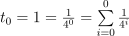 , so
, so  . Therefore, it has a predecessor
  , for which we must have
  , since was minimal. But then,
  . Contradiction.
Obviously, Achilles will pass the tortoise at some point, and obviously, this point is greater than all . We want to find out more about this point where he passes the tortoise.
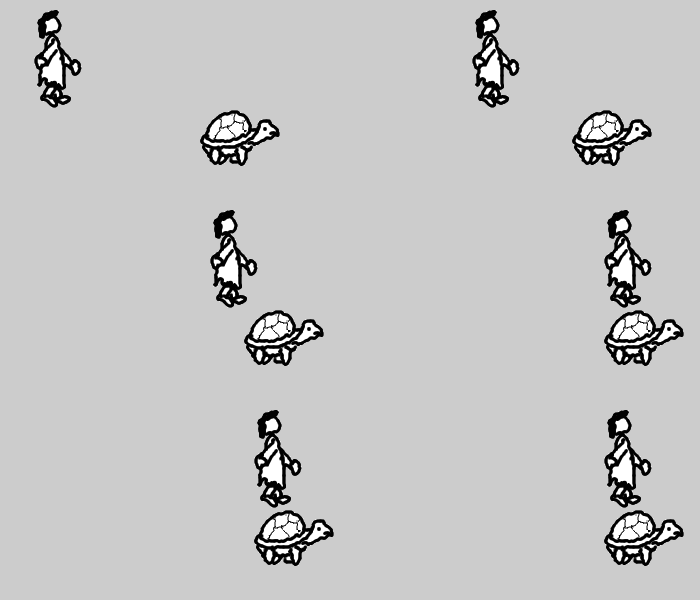
The point we are looking for, is . In fact, this is provable. But it is a bit harder than the above induction. What we have here, is a so-called geometric series. As we have
  , we have
  , that is,
  and
and  differ in the terms
  and
and  , and thus we have





(source)
We start this chapter with a nice story, "Achilles and the Tortoise", one of Zeno's Paradoxes, though we slightly adapt it. So, Achilles races against a tortoise. He gives the tortoise a 1 mile head start. Assuming Achilles is four times as fast as the tortoise, when he arrives 1 mile, the tortoise is at 1.25 miles. When he arrives 1.25, the tortoise is at 1.3125 miles. When he arrives at 1.3125, the tortoise is at 1.328125. And so on. Whenever Achilles reaches the point the tortoise was when he started, the tortoise already went further. This way, Achilles would have to go through infinitely many points, before reaching the tortoise.
Of course, this is not really a paradoxon. The problem lies in the fact that we have an infinitary process in here. As mathematicians do, we write the problem down more formally. Let
Using the axioms we saw in Part 1, we can prove this formally (if you are already a little confused, just skip this proof, it is not necessary for the further understanding): Assume there is an
Obviously, Achilles will pass the tortoise at some point, and obviously, this point is greater than all
The point we are looking for, is
From this, we see that, the larger gets, the smaller gets, and therefore, for very large , approaches  . In fact, if we did a little more preliminary work, this would be a valid mathematical proof, and mathematicians would write
  , where
  is the symbol for "infinity", and call the limit of this series. As we wrote
  for the finite sum, we can also write
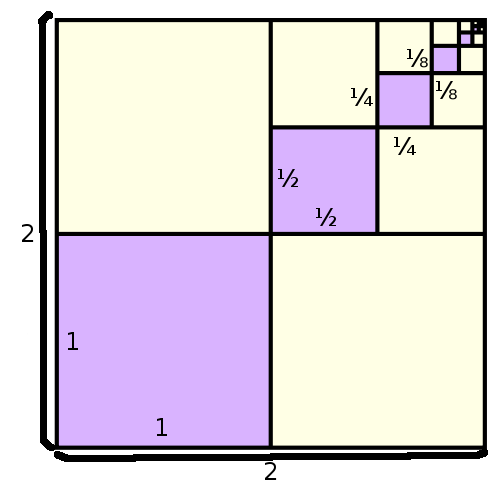
  for its limit. The following graphic gives a certain geometric intuition of this fact:
(source)

Of course, it is not always that easy, not every infinite process has a finite outcome. For example, obviously, the infinite sum 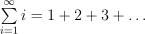 does not. However, we know that its finite parts get arbitrarily large, so we might say that
  . This series diverges, while the above geometric series converges.
But even worse, consider the series  . Its finite parts are either or
  . But you cannot find any "tendency" on what happens during infinty. This series neither converges nor diverges.
  is not well-defined.
The above example with the tortoise was one special geometric series, the general (infinite) geometric series is  , which converges for
  , and then has the limit
  - in the case, we had
  , for a general proof, consider the Wikipedia-article, or any good introduction to calculus.
Even more general, we have  . With this formula, we can prove a fact quite a lot of people are not willing to understand:
  , where
  means the zero with infinitely many nine-digits after the decimal point. But in fact, we have
  , which is
  , which is, according to our formula,
  .
.
There is a general law about recurring decimal numbers you may know from school, namely,  . For example, from this follows the above,
  . More precisely written, we have
 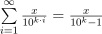 , which follows by our above formula by
  .
.
As you see, studying this kind of objects can get very complicated, but produces a lot of interesting outcomes. If you did not quite get the last part, do not worry, it is rather sophisticated for a non-mathematician.
Show comments (Requires JavaScript, loads external content and cookies from Disqus.com)
Sat, 24 Dec 2011 21:37:36 GMT

(Based on a true story.)
Mon, 19 Dec 2011 23:30:00 GMT
#! /bin/bash

width=22
text=0110110011011101111001011010110101110111011\
000001000010111011101100110101101011101110110011\
0101101000100011001

(
 textlen=$(echo -n "$text" | wc -c)
 height=$((textlen/width))
 echo new $((8*width)),$((8*height))
 echo fill 10,10,255,255,255
 j=0; while [ "$j" -lt "$height" ]; do
  i=0; while [ "$i" -lt "$width" ]; do
   ftext=${text:0:1}
   text=${text:1}
   if [ "$ftext" "=" "0" ]; then
    echo frect $((8*i)),$((8*j)),$((8*i+8)),$((8*j+8)),0,0,0;
   fi
   ((i++))
  done
  ((j++))
 done
 echo output hi.gif
) | flydraw
Sat, 17 Dec 2011 16:00:00 GMT
Infinity. One central mathematical concept on which many myths have spread, especially in the world outside science. Therefore, I had the idea of writing a series of blog-posts about several aspects of "Infinity".
These posts are not scientific, they are for non-Mathematicians, to demystify the concept of "infinity". But neither is it one of those texts that try to include a lot of "history" and interesting side facts. I just want to give a slight understanding of infinity to non-Mathematicians.
So, in this first post, we shall have a short look at the numbers as such. First, everyone knows the non-negative integers . There are "infinitely many" of them, since every number has a unique successor
  . This should be intuitive to everybody, and in fact, it is an axiom of arithmetic: Every number has a unique successor. Additionally, we have to postulate that every number except has a predecessor.
Another thing you quickly notice: Take an arbitrary sequence of decreasing non-negative integers (that is, start somewhere, and then "count down", possibly leaving steps out), then this sequence will be of finite length: You will soon or later bump into. A bit more complicated, think of an arbitrary set  of non-negative integers. Take, for example, the primes, the odd numbers, the even numbers, the phone numbers of your neighbourhood. You will notice that also every of these sets has a minimal element, even though the set itself may contain infinitely many non-negative integers. That is another axiom of arithmetic: Every non-empty set of non-negative integers has a smallest element.
These two axioms plus the existence of are, in fact, sufficient for elementary arithmetic. A whole lot of theorems can just be implied by these axioms. A simple example: Every number is either of the form  or
or  - of course, this is not very profound, it essentially states that every number is odd or even, but we only want to give a simple example. To prove it, assume there was some number
  which cannot be written in that way, then by our axiom, there exists a minimal such . Since
  , we know that
  , and therefore, by axiom, it has a predecessor
  , and as was the smallest number which can not be written in that form, we know that there is an such that
  or
or  . If , then
  , which we did not allow for . If , then
  , which is also not allowed. This is a contradiction! So, such a cannot exist: All numbers may be written in that form.

Found at KnowYourMeme Now, of course, there are further objects that are commonly called "numbers". When doing accounting, you are certainly familiar with negative integers. So we get the set of all integers,  . They do not share the property that every set of them has a smallest element. There are infinitely many of them into "both sides". So intuitively, there are "more" integers than non-negative integers - of course, the latter is a subset of the first.
But what does it mean for two sets of objects to have the same "number" of elements? Let us first look at the finite case. Let us say you are counting apples. You will take one of them and say "one", then a second one, saying "two", and a third one, saying "three", and so on, until no apple is left that was not counted. Let as assume you counted ten apples. You think you just counted the apples, but what you actually did was giving a one-to-one-mapping between apples and the set . Of course, you probably did not memorize the order you chose the apples - because it does not matter which mapping you chose, the important fact is that there is such a mapping. Such a one-to-one-mapping between two sets is called a bijection. Even in our example, there are many such bijections (calculating the actual number is left as an exercise), and you only chose one by random.
So, for the finite case, we can conclude that two sets have the same number of elements, if there is a bijection between them. For the infinite case, this becomes the definition. Two infinite sets are of equal size, if and only if there is a bijection between them.
Now, let us go back to the integers. We tried to conclude that since the non-negative integers are a subset of the integers, there must be less of them. But on the other hand, define a mapping , that is,
  is
is  . This is a bijection. So in fact, there are as many non-negative integers, as there are integers at all - even though this might not be intuitive, when looking at the finite case.
In fact, this strange behaviour of infinite sets can be used to classify them: A set is finite if and only if there is no bijection into one of its proper subsets. As there are other (mostly equivalent) definitions of finity and infinity, the concept defined here is sometimes called Dedekind-Finity.
Found at Fukung.
This concept is probably hard to understand for a non-Mathematician. The problem is that "finity" is such an intuitive concept, that every non-Mathematician will postulate it was "clear". But this is not the mathematical way of thinking. We will get deeper into this topic in one of the following posts on infinity, when we look at cardinalities. For now, let us get back to numbers.
Of course, even a non-Mathematician knows that there is more than integers. We can extend the numbers to fractions. The set of fractions is called , and it contains all fractions of the form
  where
where  and
and  are integers, where
  . Fractions have a nice property: between two distinct fractions, there is always a third one. For example, between and , there is
  . Even worse, from this directly follows that between two distinct fractions, there are always infinitely many other fractions.
For example, between and , there are the fractions  . We have "infinity on finite place", so infinity does not yield distance in any sense. Even worse, we will later show that there is a bijection between integers and fractions: Even though we can squeeze infinitely many of them between and , there are not "more" fractions than integers in the above sense.
As everybody should know from school, every fraction can also be written as a decimal fraction, with either finitely many digits or as a recurring fraction. However, we always find finitely many digits to specify them exactly.
And as many of you will probably know, there are also numbers that do not have this property. For example, , the constant to calculate the area of a circle, has no finite nore a recurring decimal representation, only approximations can be written that way. In general, every infinite sequence of digits which has a dot after finitely many steps can be considered a number, like ,
  , etc., and the set of these numbers are called the real numbers, and their set is called
  . It can be proved that is actually bigger than
  . We will later see, how this is done.
Found at Mighty Wombat. Usually, the general education stops at , even though there is a larger set of numbers, the complex numbers,  , which many non-Mathematicians do not consider as numbers, because it goes further than what they usually do with numbers. However, it is relevant in science, and mathematically, it is probably more beautiful than . Besides all real numbers, it contains, for example, the imaginary unit , for which we have
  , it is (one) "square root" of
  , which we do not have in .
An object which is often associated with is the real line: The real numbers can be considered an infinite line which contains all of them. Then, the following graphic illustrates a bijection between the real numbers between and and all real numbers:
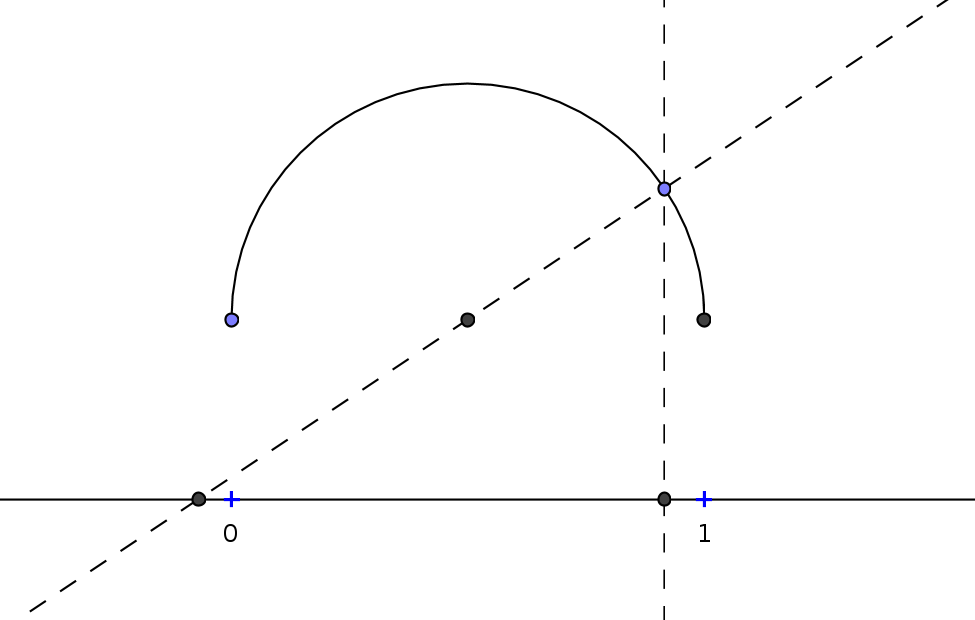
Especially interesting is that and can somehow be considered as the images of the negative and positive "infinity".
So far for this time.
These posts are not scientific, they are for non-Mathematicians, to demystify the concept of "infinity". But neither is it one of those texts that try to include a lot of "history" and interesting side facts. I just want to give a slight understanding of infinity to non-Mathematicians.
So, in this first post, we shall have a short look at the numbers as such. First, everyone knows the non-negative integers
Another thing you quickly notice: Take an arbitrary sequence of decreasing non-negative integers (that is, start somewhere, and then "count down", possibly leaving steps out), then this sequence will be of finite length: You will soon or later bump into
These two axioms plus the existence of
Found at KnowYourMeme
But what does it mean for two sets of objects to have the same "number" of elements? Let us first look at the finite case. Let us say you are counting apples. You will take one of them and say "one", then a second one, saying "two", and a third one, saying "three", and so on, until no apple is left that was not counted. Let as assume you counted ten apples. You think you just counted the apples, but what you actually did was giving a one-to-one-mapping between apples and the set
So, for the finite case, we can conclude that two sets have the same number of elements, if there is a bijection between them. For the infinite case, this becomes the definition. Two infinite sets are of equal size, if and only if there is a bijection between them.
Now, let us go back to the integers. We tried to conclude that since the non-negative integers are a subset of the integers, there must be less of them. But on the other hand, define a mapping
In fact, this strange behaviour of infinite sets can be used to classify them: A set is finite if and only if there is no bijection into one of its proper subsets. As there are other (mostly equivalent) definitions of finity and infinity, the concept defined here is sometimes called Dedekind-Finity.
Found at Fukung.
Of course, even a non-Mathematician knows that there is more than integers. We can extend the numbers to fractions. The set of fractions is called
For example, between
As everybody should know from school, every fraction can also be written as a decimal fraction, with either finitely many digits or as a recurring fraction. However, we always find finitely many digits to specify them exactly.
And as many of you will probably know, there are also numbers that do not have this property. For example,
Found at Mighty Wombat.
An object which is often associated with
Especially interesting is that
So far for this time.
Tue, 13 Dec 2011 22:41:12 GMT
A great article, with interesting references, and as it is about something many people do not seem to understand, worth reading:
> The abstraction-optimization tradeoff
> The abstraction-optimization tradeoff
Tue, 06 Dec 2011 20:38:29 GMT
Mon, 05 Dec 2011 16:30:04 GMT
At the station where I leave the train every week, there is a tunnel where often street musicians play their music. Mostly, their play is so bad and annoying that you want to pay them rather for stopping it, than for playing. However, today, I heard some nice melody from this tunnel, and I thought, maybe a band or something is playing there.
Approaching the source, I saw an old woman, playing on a small electrical piano. Looking a little closer, I found that some keys were missing on the keyboard, and obviously, she was only pretending to play - her keystrokes did not sync with the music, the music was obviously played by that gadget automatically.
I am not sure whether this person was snaky, or just naive to think that nobody will notice, or both. However, at least she knew how to play this gadget in a way that it does not make annoying sounds, even though that only means to choose a track and play it, it is better than what the other people do. And that wtf-feel about it somehow made me smile. I gave her 50 cent, to help her repairing the missing keys on her keyboard.
Approaching the source, I saw an old woman, playing on a small electrical piano. Looking a little closer, I found that some keys were missing on the keyboard, and obviously, she was only pretending to play - her keystrokes did not sync with the music, the music was obviously played by that gadget automatically.
I am not sure whether this person was snaky, or just naive to think that nobody will notice, or both. However, at least she knew how to play this gadget in a way that it does not make annoying sounds, even though that only means to choose a track and play it, it is better than what the other people do. And that wtf-feel about it somehow made me smile. I gave her 50 cent, to help her repairing the missing keys on her keyboard.
Wed, 30 Nov 2011 14:22:54 GMT
... gab letzens eine Mitarbeiterin der geliebten TU-Mensa von sich, vermutlich unüberlegt und genervt vom Riechverhalten meines Kommilitonen.
Meinen Kommentar, dies sei im Allgemeinen ein schlechtes Motto für eine Küche, hat sie offenbar nicht verstanden.
Meinen Kommentar, dies sei im Allgemeinen ein schlechtes Motto für eine Küche, hat sie offenbar nicht verstanden.
Sun, 27 Nov 2011 15:20:32 GMT
... you cannot do anything about it. It sometimes happens. And sometimes it comes so fast, that you cannot react properly on it. But mostly, you notice that you have to cough before you do it.
Especially, you can put something in front of your mouth. Even if it appears like nothing leaves your mouth, when coughing, you spit some stuff, even if you do not see it. That is why children are told to put their hands in front of their mouths.
Usually, this is not a good idea, since you will touch a lot of other stuff with your hand. One should better use either some tissue, or your elbow.
However, it appears that many people have not been told to do so. When sitting in trains or busses, especially in winter, I see people szneesing and coughing, without putting something in front of their mouth, almost every time.
This is disgusting! And it is antisocial - it makes other people sick!
Especially, you can put something in front of your mouth. Even if it appears like nothing leaves your mouth, when coughing, you spit some stuff, even if you do not see it. That is why children are told to put their hands in front of their mouths.
Usually, this is not a good idea, since you will touch a lot of other stuff with your hand. One should better use either some tissue, or your elbow.
However, it appears that many people have not been told to do so. When sitting in trains or busses, especially in winter, I see people szneesing and coughing, without putting something in front of their mouth, almost every time.
This is disgusting! And it is antisocial - it makes other people sick!