Sat, 16 Oct 2010 15:17:38 GMT
For some reason I do not really quite understand, I noticed that running VirtualBox-VMs on Blockdevices rather than Container Files can make them a lot faster. On the other hand, I dont like playing arount with my partition table, as partition tables are not meant to do this and therefore not very flexible.
However LVM is flexible enough, and seems pretty fast to me, too. So I created a logical volume on which I installed my Virtual Machine, and it seems like it is really a lot faster thanusing a file container.
The first thing to do is creating a logical volume in the volume group (which is called vg0 for me), which must usually be done as root
# lvcreate -n vm1 -L 60G vg0
Usually, this device is given the wrong permissions, and unfortunately, LVM seems not to have an additional mechanism for setting the device owner, so I used an additional udev-rule. Using
# udevadm monitor --property
one can see all udev-Events with their properties. By
# lvchange -a n /dev/vg0/vm1
# lvchange -a y /dev/vg0/vm1
we can create and remove this volume from the /dev-tree, and udevadm will output a lot of information belonging to that device. There are a lot of unique values, I chose to use DM_LV_NAME which should be "vm1" in that case, though it might not be unique (if one has more than one volume group with equally-named logical volumes).
Lets say my user-account is called "user". Then I have to create a file /etc/udev/rules.d/99-vm1 with the content
DM_LV_NAME=="vm1", OWNER:="user", MODE:="600"
then removing the device, restarting udevd and loading it again should be sufficient for the right permissions, if not, restarting the computer should be.
# lvchange -a n /dev/vg0/vm1 && killall udevd && udevd --daemon && lvchange -a y /dev/vg0/vm1
Now I should be able to access /dev/vg0/vm1 as user. By
$ VBoxManage internalcommands createrawvmdk -filename vm1.vmdk -rawdisk /dev/vg0/vm1
a vmdk-file that points to that device can be created, which can then be included into a virtual machine as usual.
At least this worked for me.
The configured Virtual Machines appear to be a lot faster that way, however, one drawback is that this setup seems to slow down the host system. But I will probably continue using this setup.
However LVM is flexible enough, and seems pretty fast to me, too. So I created a logical volume on which I installed my Virtual Machine, and it seems like it is really a lot faster thanusing a file container.
The first thing to do is creating a logical volume in the volume group (which is called vg0 for me), which must usually be done as root
# lvcreate -n vm1 -L 60G vg0
Usually, this device is given the wrong permissions, and unfortunately, LVM seems not to have an additional mechanism for setting the device owner, so I used an additional udev-rule. Using
# udevadm monitor --property
one can see all udev-Events with their properties. By
# lvchange -a n /dev/vg0/vm1
# lvchange -a y /dev/vg0/vm1
we can create and remove this volume from the /dev-tree, and udevadm will output a lot of information belonging to that device. There are a lot of unique values, I chose to use DM_LV_NAME which should be "vm1" in that case, though it might not be unique (if one has more than one volume group with equally-named logical volumes).
Lets say my user-account is called "user". Then I have to create a file /etc/udev/rules.d/99-vm1 with the content
DM_LV_NAME=="vm1", OWNER:="user", MODE:="600"
then removing the device, restarting udevd and loading it again should be sufficient for the right permissions, if not, restarting the computer should be.
# lvchange -a n /dev/vg0/vm1 && killall udevd && udevd --daemon && lvchange -a y /dev/vg0/vm1
Now I should be able to access /dev/vg0/vm1 as user. By
$ VBoxManage internalcommands createrawvmdk -filename vm1.vmdk -rawdisk /dev/vg0/vm1
a vmdk-file that points to that device can be created, which can then be included into a virtual machine as usual.
At least this worked for me.
The configured Virtual Machines appear to be a lot faster that way, however, one drawback is that this setup seems to slow down the host system. But I will probably continue using this setup.
Show comments (Requires JavaScript, loads external content and cookies from Disqus.com)
Fri, 15 Oct 2010 00:53:20 GMT
Sun, 10 Oct 2010 23:44:21 GMT
If you know me, you will know that animal rights are a very important topic to me. I am a vegetarian, and already tried to become a vegan, which I couldnt manage so far, unfortunately. Till some years ago I had a pet - a dog which I loved and I was very sad when he died. This dog was one of the most important sources of my belief in the value of animal life.
I always loved animals somehow. I grew up in a village with a lot of farms, e.g. cowsheds and piggeries, which were there before the time when reasonable animal protection laws were introduced in germany, thus the cows were chained and the pigs were pent-up. But since I grew up there and already saw some pigs being slaughtered, this was a normal thing to me. I loved cows and pigs, but I never thought about them suffering in the position they were. Well, until the farm of our neighbours burned down, with about a dozen cows and bulls (iirc), and some pigs. This was the first time when I considered becoming vegetarian - when you see cows dying in a fire, you really think about whether you can still eat them. But well, I was about 9 years old, and at some point, I started to eat meat again, I stopped it again about 6 years later if I remember correctly.
Meanwhile, a lot has changed, and animal protection, as well as animal rights, have become a topic of wide interest, at least in germany. And at least in germany, almost no catering can afford not to offer at least some vegetarian food. There are a lot of motivations for vegetarianism, actually, just not wanting an animal to die for oneself is meanwhile considered naive, compared to the many other reasons like health and environment. Anyway, environment protection always comes along with animal protection, but has always been a medium, not a major goal to me.
At school, some teachers almost went crazy because I wouldnt let them tell me that there is a moralic difference between humans and animals. But I simply couldnt see one. I didnt consider the main arguments that were given to me being thought through.
For example, the main argument for this is probably (still) the superior intelligence and consciousness of humans. A funny fact about this is that our school was next to a home for the handicapped, and therefore we were often told that we have to respect mentally disabled people, as they are also humans and also have a right to live. I am not only talking about people with down-syndrome or similar diseases, which may be less intelligent than average people, but can take part at normal life when aided properly. I am talking about really disabled people, people which live their entire (mostly short) lives bound to a wheelchair, sometimes being blind, sometimes being deaf, sometimes being unable to move, mostly being heavily distorted. There are people which have an intelligence inferior to some animals - and I want them to have human rights, too. But if I evaluate living things by their intelligence, it wouldnt be consistent anymore. Unfortunately, most people simply stopped the discussion at this point, comparing my argumentation to social darwinism, but in fact it is not me who is evaluating life forms by terms of evolution - they do, by extolling themselves over animals.
Furthermore, while the human intelligence may mostly be superior to other animals, there are other facilities in which other kinds are superior. Eagles have superior sight, monkeys are superior at climbing, cats are superior at jumping, birds and bats can fly. These facilities have evolved by evolution, and it turns out that intelligence is somehow superior to them, because in the end, it gives you the power of controlling other kinds, and copy their facilities by technology. So yes, intelligence a great thing, but I dont see the relevance for moral decisions.
Another argument which is often given is that animals have much higher reproduction rates than humans. Since they have, it is no problem to torture and kill a few of them, since there are still enough of them left. Thus, not considering an animal as an individual, but as part of a large group of animals, which are only thare to reproduce and keep up their kind.
Some animals like mice may have a very high reproduction rate, but others like elephants and rhinos, do not. Hence, this is not true for all kinds of animals. And one has to think about the high reproduction rates of humans in ancient times - there are more than 6 billion people out there, vitally no place on earth is not inhabited by humans. That is a lot, more than some other species. And I doubt that the reproduction rate of humans would be so low if we didnt have contraceptives. If we rate the value of an individual animal by its meaning for the population of its species, why should we do something else with humans, therefore devaluating infertile, gay or even unalluring people. We would have to give humans an additional value to justify this argument to give humans an additional value - this is circular reasoning.
Yet another argument I often hear is that if other animals were superior to us, they would do the same to us. From the arguments given so far, this one is the one that is still the most plausible to me, as it doesnt try to extoll humans to animals, but see them as a species like any other, which just has the luck of being mightier than the others. So from all of the given arguments, this is the only one that I appreciate for trying to really analyze the situation.
But well, this is an assumption. There is no proof for this. There are animals which are herbivores and would therefore certainly not eat other kinds of animals, but on the other hand, its plausible that they would still have some use of other animals, like producing manure for growing plants, or doing heavy work. On the other hand, there are a lot of humans who do not want to suppress animals. Hence, it is plausible that members of other species would also, at some point, consider this morally wrong. Maybe their process of making political decisions differs from ours, and hence it could happen that this awareness of the suffering of other kinds would spread faster than under humans. The main problem here is, that we cannot say much about intelligent species, since we basically know only one, and we cant be sure to be impartial when evaluating it, since we belong to it.
And in my opinion, if we can learn one related thing from ourselves, then it is that power without responsibility almost always leads to problems. We have the power to do almost everything we want, so we should also take responsibility.
There may be still a lot of space left for debates, but lets move on. Lets say, we accept animal rights so far. Lets think about the reason why we want this kind of "rights" anyway.
I think, most people will agree that the concept of basic "rights" is there to minimize, or at least to border suffering. We all know how certain kinds of suffering feel, and we assume that other humans feel the same, and thus, there are human rights. Higher animals behave anthropomorphic when feeling pain, so they are also given some rights, because we assume that these animals feel similar to us. Fish, while having an anatomically different way of feeling pain, also behaves in a way that we see if it feels pain. It behaves like we would intuitively expect by something that feels pain.
Lower animals like insects or spiders do not behave this way. But still, if you pull out their wings or legs, they intuitively seem to suffer from it, they do not behave like they dont care. Earthworms and snails also seem to behave as we would expect from something that feels pain. So somehow, we may not have a problem with poisoning snails that are destroying our garden, but most people have a problem with stepping on a snail or worm and seeing it being convulsed with pain.
Some people even give plants basic rights, like frutarians that only eat what can be harvested without killing the plant. As this is a rather modern movement, there is not much thinking done yet. There are some plants that want to be eaten, or at least do take an advantage of it, like tomatoes. There are some plants that regularly die every year, like corn, which is usually harvested when it is already parched. There are also plants which can reproduce themselves by dropping branches which then take roots themselves, like the chinese willow.
On the other hand, there are plants that react on being hurt by sending out poison and messengers to other plants, like acaciae. Intuitively, this is some sort of pain, and we maybe should try to take care of it.
Now, after giving a slight introduction to that topic, lets move on to the reason for this post anyway, and the topic I want to get at.
I can remember a lot of interesting discussions in my biology course at school. One was about the chances and risks of genetic engineering. Animals could suffer from genetic manipulation, which is a risk. On the other hand, I made the suggestion of maybe someday being able to create animals without a brain and therefore could not feel pain. My teacher answered that this would also be a torture to that animal. At this point I didnt quite understand what she meant. And recently, two people asked me what I think about animals without a CNS.
While in the cases mentioned before it is rather clear what "suffering" and "pain" means, in these cases it is not. We can even go further and talk about machines that behave like feeling pain, and there are films about this topic. With the Holo Doctor in Star Trek: Voyager this kind of problem occurs many times, same for Data. The film A.I. is almost entirely about that topic. Though this is currently just science fiction, there may come a day when we will be able to create an artificial life form in that way, and then we will run into these problems.
In the end, this boils down to two questions: What is "pain" and "suffering", and what is "live" at all. This leads to an even more general problem, and there is an interesting essay by Paul Graham about it. While giving a lot of other interesting statements, one statement is that "the concepts we use in everyday life are fuzzy, and break down if pushed too hard". And thats somehow the case here. We dont have an universal definition of "pain", there is no formal system that can really decide that for us. Maybe someday we will have such a system, but for now, we just have to make the best out of what we have by now, and you will always find edge cases in which this definition is not clear or even makes no sense. The foundations of mathematics were not built up in one day, and there are many theories that were less formal, before somebody finally invented a strictly formal system around them. We need to take this problem serious and think about it, so we can maybe find a consistent formal system one day that also satisifes our intuition. But until we have it, we must not throw away theories just because of edge cases in which they may not be consistent. However, you may have noticed that I also used some edge cases in my argumentations - that is because I claim that my thoughts handle these edge cases better, but it doesnt mean that there may not be a superior theory that can handle with the edge cases of my thoughts. Every theory I know has some flaws, and it is a common and easy way of trolling people to show them these flaws, because most people are simply never thinking that far, but its not a proper way of reasoning, when the own theory is inferior.
What remains is the question what to do then. How can we behave morally correct.
I think the first thing we can learn of all this is that we simply have to accept that the world is a cruel place. We cannot live without giving death, pain and suffering to other living things. But we also cannot die, because inside us there is a strong will to survive, which can not be broken by the "everyday-suffering", and which makes us taking high efforts for saving it.
In the end, I think, one just has to accept that as a given fact, and make the best out of it. We must accept that we want to live, even though this means that other creatures must be killed, but we should at least be aware of it. We need to think about how much suffering we have to produce, and minimize it as far as possible. And we need to always respect the things that may suffer from us. The real problem is not humans harvesting corn, but humans who dont take it serious that this corn may suffer in some way, and laugh about people thinnking about this.
Not long ago, I was told a proposition which is probably the best thing to do: Try to behave better than the average person.
It is impossible to be perfect - especially because we cannot even tell what "perfect" means at all. It can be very exhausting to try to be perfect, especially when you cannot conform to your own requirements, and at that point, it may even be counterproductive, because other people might see you fail and that might keep them from trying to behave better themselves. If you do as much as you can, then maybe you will inspire other people to do the same. If one person behaves perfectly (whatever that means), but nobody else does, it doesnt help anybody. But if many people try to be better that the average person, the world could get better.
I always loved animals somehow. I grew up in a village with a lot of farms, e.g. cowsheds and piggeries, which were there before the time when reasonable animal protection laws were introduced in germany, thus the cows were chained and the pigs were pent-up. But since I grew up there and already saw some pigs being slaughtered, this was a normal thing to me. I loved cows and pigs, but I never thought about them suffering in the position they were. Well, until the farm of our neighbours burned down, with about a dozen cows and bulls (iirc), and some pigs. This was the first time when I considered becoming vegetarian - when you see cows dying in a fire, you really think about whether you can still eat them. But well, I was about 9 years old, and at some point, I started to eat meat again, I stopped it again about 6 years later if I remember correctly.
Meanwhile, a lot has changed, and animal protection, as well as animal rights, have become a topic of wide interest, at least in germany. And at least in germany, almost no catering can afford not to offer at least some vegetarian food. There are a lot of motivations for vegetarianism, actually, just not wanting an animal to die for oneself is meanwhile considered naive, compared to the many other reasons like health and environment. Anyway, environment protection always comes along with animal protection, but has always been a medium, not a major goal to me.
At school, some teachers almost went crazy because I wouldnt let them tell me that there is a moralic difference between humans and animals. But I simply couldnt see one. I didnt consider the main arguments that were given to me being thought through.
For example, the main argument for this is probably (still) the superior intelligence and consciousness of humans. A funny fact about this is that our school was next to a home for the handicapped, and therefore we were often told that we have to respect mentally disabled people, as they are also humans and also have a right to live. I am not only talking about people with down-syndrome or similar diseases, which may be less intelligent than average people, but can take part at normal life when aided properly. I am talking about really disabled people, people which live their entire (mostly short) lives bound to a wheelchair, sometimes being blind, sometimes being deaf, sometimes being unable to move, mostly being heavily distorted. There are people which have an intelligence inferior to some animals - and I want them to have human rights, too. But if I evaluate living things by their intelligence, it wouldnt be consistent anymore. Unfortunately, most people simply stopped the discussion at this point, comparing my argumentation to social darwinism, but in fact it is not me who is evaluating life forms by terms of evolution - they do, by extolling themselves over animals.
Furthermore, while the human intelligence may mostly be superior to other animals, there are other facilities in which other kinds are superior. Eagles have superior sight, monkeys are superior at climbing, cats are superior at jumping, birds and bats can fly. These facilities have evolved by evolution, and it turns out that intelligence is somehow superior to them, because in the end, it gives you the power of controlling other kinds, and copy their facilities by technology. So yes, intelligence a great thing, but I dont see the relevance for moral decisions.
Another argument which is often given is that animals have much higher reproduction rates than humans. Since they have, it is no problem to torture and kill a few of them, since there are still enough of them left. Thus, not considering an animal as an individual, but as part of a large group of animals, which are only thare to reproduce and keep up their kind.
Some animals like mice may have a very high reproduction rate, but others like elephants and rhinos, do not. Hence, this is not true for all kinds of animals. And one has to think about the high reproduction rates of humans in ancient times - there are more than 6 billion people out there, vitally no place on earth is not inhabited by humans. That is a lot, more than some other species. And I doubt that the reproduction rate of humans would be so low if we didnt have contraceptives. If we rate the value of an individual animal by its meaning for the population of its species, why should we do something else with humans, therefore devaluating infertile, gay or even unalluring people. We would have to give humans an additional value to justify this argument to give humans an additional value - this is circular reasoning.
Yet another argument I often hear is that if other animals were superior to us, they would do the same to us. From the arguments given so far, this one is the one that is still the most plausible to me, as it doesnt try to extoll humans to animals, but see them as a species like any other, which just has the luck of being mightier than the others. So from all of the given arguments, this is the only one that I appreciate for trying to really analyze the situation.
But well, this is an assumption. There is no proof for this. There are animals which are herbivores and would therefore certainly not eat other kinds of animals, but on the other hand, its plausible that they would still have some use of other animals, like producing manure for growing plants, or doing heavy work. On the other hand, there are a lot of humans who do not want to suppress animals. Hence, it is plausible that members of other species would also, at some point, consider this morally wrong. Maybe their process of making political decisions differs from ours, and hence it could happen that this awareness of the suffering of other kinds would spread faster than under humans. The main problem here is, that we cannot say much about intelligent species, since we basically know only one, and we cant be sure to be impartial when evaluating it, since we belong to it.
And in my opinion, if we can learn one related thing from ourselves, then it is that power without responsibility almost always leads to problems. We have the power to do almost everything we want, so we should also take responsibility.
There may be still a lot of space left for debates, but lets move on. Lets say, we accept animal rights so far. Lets think about the reason why we want this kind of "rights" anyway.
I think, most people will agree that the concept of basic "rights" is there to minimize, or at least to border suffering. We all know how certain kinds of suffering feel, and we assume that other humans feel the same, and thus, there are human rights. Higher animals behave anthropomorphic when feeling pain, so they are also given some rights, because we assume that these animals feel similar to us. Fish, while having an anatomically different way of feeling pain, also behaves in a way that we see if it feels pain. It behaves like we would intuitively expect by something that feels pain.
Lower animals like insects or spiders do not behave this way. But still, if you pull out their wings or legs, they intuitively seem to suffer from it, they do not behave like they dont care. Earthworms and snails also seem to behave as we would expect from something that feels pain. So somehow, we may not have a problem with poisoning snails that are destroying our garden, but most people have a problem with stepping on a snail or worm and seeing it being convulsed with pain.
Some people even give plants basic rights, like frutarians that only eat what can be harvested without killing the plant. As this is a rather modern movement, there is not much thinking done yet. There are some plants that want to be eaten, or at least do take an advantage of it, like tomatoes. There are some plants that regularly die every year, like corn, which is usually harvested when it is already parched. There are also plants which can reproduce themselves by dropping branches which then take roots themselves, like the chinese willow.
On the other hand, there are plants that react on being hurt by sending out poison and messengers to other plants, like acaciae. Intuitively, this is some sort of pain, and we maybe should try to take care of it.
Now, after giving a slight introduction to that topic, lets move on to the reason for this post anyway, and the topic I want to get at.
I can remember a lot of interesting discussions in my biology course at school. One was about the chances and risks of genetic engineering. Animals could suffer from genetic manipulation, which is a risk. On the other hand, I made the suggestion of maybe someday being able to create animals without a brain and therefore could not feel pain. My teacher answered that this would also be a torture to that animal. At this point I didnt quite understand what she meant. And recently, two people asked me what I think about animals without a CNS.
While in the cases mentioned before it is rather clear what "suffering" and "pain" means, in these cases it is not. We can even go further and talk about machines that behave like feeling pain, and there are films about this topic. With the Holo Doctor in Star Trek: Voyager this kind of problem occurs many times, same for Data. The film A.I. is almost entirely about that topic. Though this is currently just science fiction, there may come a day when we will be able to create an artificial life form in that way, and then we will run into these problems.
In the end, this boils down to two questions: What is "pain" and "suffering", and what is "live" at all. This leads to an even more general problem, and there is an interesting essay by Paul Graham about it. While giving a lot of other interesting statements, one statement is that "the concepts we use in everyday life are fuzzy, and break down if pushed too hard". And thats somehow the case here. We dont have an universal definition of "pain", there is no formal system that can really decide that for us. Maybe someday we will have such a system, but for now, we just have to make the best out of what we have by now, and you will always find edge cases in which this definition is not clear or even makes no sense. The foundations of mathematics were not built up in one day, and there are many theories that were less formal, before somebody finally invented a strictly formal system around them. We need to take this problem serious and think about it, so we can maybe find a consistent formal system one day that also satisifes our intuition. But until we have it, we must not throw away theories just because of edge cases in which they may not be consistent. However, you may have noticed that I also used some edge cases in my argumentations - that is because I claim that my thoughts handle these edge cases better, but it doesnt mean that there may not be a superior theory that can handle with the edge cases of my thoughts. Every theory I know has some flaws, and it is a common and easy way of trolling people to show them these flaws, because most people are simply never thinking that far, but its not a proper way of reasoning, when the own theory is inferior.
What remains is the question what to do then. How can we behave morally correct.
I think the first thing we can learn of all this is that we simply have to accept that the world is a cruel place. We cannot live without giving death, pain and suffering to other living things. But we also cannot die, because inside us there is a strong will to survive, which can not be broken by the "everyday-suffering", and which makes us taking high efforts for saving it.
In the end, I think, one just has to accept that as a given fact, and make the best out of it. We must accept that we want to live, even though this means that other creatures must be killed, but we should at least be aware of it. We need to think about how much suffering we have to produce, and minimize it as far as possible. And we need to always respect the things that may suffer from us. The real problem is not humans harvesting corn, but humans who dont take it serious that this corn may suffer in some way, and laugh about people thinnking about this.
Not long ago, I was told a proposition which is probably the best thing to do: Try to behave better than the average person.
It is impossible to be perfect - especially because we cannot even tell what "perfect" means at all. It can be very exhausting to try to be perfect, especially when you cannot conform to your own requirements, and at that point, it may even be counterproductive, because other people might see you fail and that might keep them from trying to behave better themselves. If you do as much as you can, then maybe you will inspire other people to do the same. If one person behaves perfectly (whatever that means), but nobody else does, it doesnt help anybody. But if many people try to be better that the average person, the world could get better.
Sun, 10 Oct 2010 17:28:50 GMT
Die PETA wird gerade in letzter Zeit, wohl dank der Anstrengungen von Nahrungsmittel- und Pharmaindustrie, oft kritisiert. Ich persönlich sehe einige Kritikpunkte durchaus ein, aber generell denke ich, viele Kritikpunkte sind einfach nur ein Ergebnis von verdrängten Moralvorstellungen.
Für einige dieser Kritikpunkte hat die deutsche Peta eine FAQ eingerichtet. An einigen Stellen betonen sie, dass sie nicht die amerikanische Peta sind, sondern eine eigene Organisation, dennoch distanzieren sie sich nicht von ihr. Das finde ich mutig, und auch ehrlich. Sie könnten sich auch feige von allem was die US-Peta tut distanzieren, was hierzulande kritisiert wird, das tut sie nicht.
Interessant fand ich ihre Stellungnahme zu ihrer Aktion "Holocaust auf dem Teller". Ich wusste zum Beispiel nicht, dass es auch Zuspruch von Holocaust-Überlebenden gab.
Für einige dieser Kritikpunkte hat die deutsche Peta eine FAQ eingerichtet. An einigen Stellen betonen sie, dass sie nicht die amerikanische Peta sind, sondern eine eigene Organisation, dennoch distanzieren sie sich nicht von ihr. Das finde ich mutig, und auch ehrlich. Sie könnten sich auch feige von allem was die US-Peta tut distanzieren, was hierzulande kritisiert wird, das tut sie nicht.
Interessant fand ich ihre Stellungnahme zu ihrer Aktion "Holocaust auf dem Teller". Ich wusste zum Beispiel nicht, dass es auch Zuspruch von Holocaust-Überlebenden gab.
Sun, 10 Oct 2010 13:12:15 GMT
Flash, Unity, Java, Silverlight, and many others, they all aimed the same - enhancing the Web - but in the end, there are only few situations where they are really useful, for films and some features like resumable file uploads or tcp-connections, mostly they are just used for stupid design-enhancements, and for games.
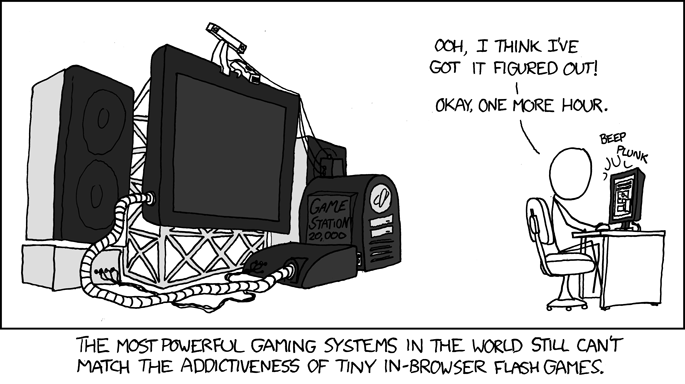
These little Browser Games have become the main topic of some websites, and seems like there are quite a few people who are making money with advertisements with them. There are so many of them. And they are so addictive - see xkcd:
And there are not only minigames. Even old games like Links Awakening can be played online.
But Flash is a closed, proprietary technology. And at least in theory, there is no reason for it, if just JavaScript would be enhanced enough - which is what is tried to be done with HTML 5. And there are yet some impressive games, for example Biolab Disaster (via), using the ImpactJS Game Engine (which has a nice little game on their website).
Currently, these games are mostly small and not that time-consuming, which is, as far as I see, the reason why they are so addictive. It is a world where you can still create simple games easily, and still, games have to convince the player by their idea rather than by their graphics.
I am afraid, with the rise of WebGL and new optimizations for JavaScript, this will change, and there may come the first JS-Games which can really compete with commercial games. The little browser games may disappear mostly.
On the other hand, maybe this will be the start of a new generation of portable games. Looking at some previews, the stuff that can be done with it is not that bad, compared to some games that are only slightly older. With some optimizations, maybe the advantages of having a larger user-base, not being addicted to another company, and - above all - a better control about the copies of the own game (in the end, large parts of the game are open source, but can still made dependent to the connection to a server), will make it an alternative for game developers.
These little Browser Games have become the main topic of some websites, and seems like there are quite a few people who are making money with advertisements with them. There are so many of them. And they are so addictive - see xkcd:
And there are not only minigames. Even old games like Links Awakening can be played online.
But Flash is a closed, proprietary technology. And at least in theory, there is no reason for it, if just JavaScript would be enhanced enough - which is what is tried to be done with HTML 5. And there are yet some impressive games, for example Biolab Disaster (via), using the ImpactJS Game Engine (which has a nice little game on their website).
Currently, these games are mostly small and not that time-consuming, which is, as far as I see, the reason why they are so addictive. It is a world where you can still create simple games easily, and still, games have to convince the player by their idea rather than by their graphics.
I am afraid, with the rise of WebGL and new optimizations for JavaScript, this will change, and there may come the first JS-Games which can really compete with commercial games. The little browser games may disappear mostly.
On the other hand, maybe this will be the start of a new generation of portable games. Looking at some previews, the stuff that can be done with it is not that bad, compared to some games that are only slightly older. With some optimizations, maybe the advantages of having a larger user-base, not being addicted to another company, and - above all - a better control about the copies of the own game (in the end, large parts of the game are open source, but can still made dependent to the connection to a server), will make it an alternative for game developers.
Fri, 08 Oct 2010 00:57:31 GMT
Interessant. Ich hätte nicht gedacht, dass mitten in München irgendwo eine Salbeipflanze wächst, so direkt im Straßengraben:

Sun, 03 Oct 2010 23:15:21 GMT
Dass Oracle Sun aufgekauft hat ist sehr schade. Kein Wunder, dass es jetzt Forks der ganzen offenen Projekte von Sun gibt. Ich hoffe ja, dass diese etwas werden, und somit Oracle am Ende kräftig abgewatscht wird. Leider bezweifle ich es, wenn ich mir zum Beispiel die Kommentare von http://www.basicthinking.de/blog/2010/09/28/openoffice-entwicklergemeinde-trennt-sich-von-oracle-und-gruendet-libreoffice/ ansehe.
OpenOffice sei demnach zurückgeblieben, "Ohne Moos nichts los", etc.
Solche Aussagen finde ich immer sehr demotivierend. Ich mag zwar nicht unbedingt viel Zeug programmiert haben das in freie Projekte einging, aber ich bemühe mich trotzdem, mich wenigstens auf andere Weise daran zu beteiligen, dass freie Software bzw. offene Formate sich durchsetzen.
Ich sehe in quelloffener Software, oder noch besser in freier Software, einen Mehrwert alleine dadurch, dass sie quelloffen bzw. frei ist - nur leider scheint diese Meinung kaum mehr jemand zu teilen.
Das mag daran liegen, dass der Freiheitsbegriff und Quelloffenheitsbegriff bisher in anderen Gebieten kaum Anwendung fand. Die Baupläne einer Maschine mögen teuer zu entwickeln sein, aber bei den meisten Maschinen kann man sie recht gut reverse-engineeren, vor Allem ist die Produktion dieser Maschinen selbst meistens hinreichend teuer.
Einzig und Allein Rezepturen fielen mir ein, die dahingehend relevant wären, diverse Cola-Sorten, diverse Saucen, diverse Medikamente vielleicht. Wobei man bei denen meistens auch recht genau feststellen kann, was drin ist, nur nicht, wie viel davon.
Die Situation bei Software ist jedenfalls eine andere: Während man selbst bei einem Getränk dessen Rezeptur man kennt einen relativ großen Aufwandt hat diese anzupassen und das geänderte Getränk zu verbreiten sodass alle von der Änderung profitieren, ist das bei Software überhaupt kein Problem. Es reichen teils winzige Änderungen, ein kleiner Button, ein paar kleine Tweaks, ein anderes Datenbank-Backend, etc., um eine Anwendung für einen größeren Benutzerkreis nützlich zu machen.
Und das ist gut so: Es spart Arbeit. Es führt zwar einerseits zu einer sehr inhomogenen Struktur, andererseits setzten sich bisher für die meisten Techniken Standards durch, die auch eingehalten werden - und nicht unbedingt weniger, als das bei kommerziellen Formaten der Fall ist. Außerdem fördert es Innovationen: Jeder kann mit einem Quellcode herumexperimentieren, und vielleicht etwas ganz neues entwickeln.
Gut, dafür muss man sich auch mehr mit der Materie auseinandersetzen, und der reine Nutzer mag sich fragen, warum er sich mit den Interna von Software auseinandersetzen sollte, wo er den Rechner doch nur nutzen will. Man müsse den Rechner demnach als Werkzeug ansehen, und Software sei dann gut, wenn man mit ihr das machen kann, was man will.
So wie ich das sehe ist allerdings die Zeit, in der die Leute Computer noch wirklich als Werkzeug angesehen haben, inzwischen vorbei. Wer seinen Computer wirklich als Werkzeug ansieht, ist zum Einen grundsätzlich bereit, dessen Funktionsweise zu lernen, und hat ein Interesse an dessen Verbesserung. Nicht umsonst gab es Open Source soweit man mir erzählte bereits vor der Free-Software-Bewegung: Unternehmen setzten Software ein die Quelloffen war, und sendeten Patches zurück an deren Hersteller, die sie einpflegten - weil das Hauptinteresse eben darin bestand, das Werkzeug passender zu machen.
Nein, ein Werkzeug ist der Computer für die wenigsten Nutzer heute. Vielleicht noch für die Seniorin, die von ihrem Enkel gelernt hat, Briefe zu schreiben und zu drucken, und E-Mails zu versenden. Die Leute interessieren sich für "Benutzerfreundlichkeit" - was dieser Begriff alleridngs genau heißt, das ist nicht so genau definiert, meistens bedeutet er, möglichst wenig Denkaufwand soll notwendig sein. Ich kann eine .PDF-Datei erzeugen und per Mail verschicken - ich kann aber auch eine .DOC-Datei in meinem Mailclient mit Office-Integration erzeugen und verschicken, gut, damit vergraule ich alle Leute die kein MS Office haben (und teils auch Leute mit einem anderen Mailclient), aber es gibt mir das Gefühl, es sei "einfacher". Ich kann in meinem Browser eine URL eingeben, aber wenn es für jede größere Webseite bereits irgendwo ein Icon in einer ellenlangen Liste gibt, das ich nur anklicken muss, fühlt sich das "einfacher" an. Und selbst das ist noch zu viel. Am Besten soll man den PC anschalten können, er macht automatisch alles was man ihm sagt, denkt selbst mit, und liefert einem dann das Ergebnis.
Ein Werkzeug ist das dann nicht mehr. Ihm kommt eher die Rolle des denkenden Teils der Arbeit zu.
OpenOffice sei demnach zurückgeblieben, "Ohne Moos nichts los", etc.
Solche Aussagen finde ich immer sehr demotivierend. Ich mag zwar nicht unbedingt viel Zeug programmiert haben das in freie Projekte einging, aber ich bemühe mich trotzdem, mich wenigstens auf andere Weise daran zu beteiligen, dass freie Software bzw. offene Formate sich durchsetzen.
Ich sehe in quelloffener Software, oder noch besser in freier Software, einen Mehrwert alleine dadurch, dass sie quelloffen bzw. frei ist - nur leider scheint diese Meinung kaum mehr jemand zu teilen.
Das mag daran liegen, dass der Freiheitsbegriff und Quelloffenheitsbegriff bisher in anderen Gebieten kaum Anwendung fand. Die Baupläne einer Maschine mögen teuer zu entwickeln sein, aber bei den meisten Maschinen kann man sie recht gut reverse-engineeren, vor Allem ist die Produktion dieser Maschinen selbst meistens hinreichend teuer.
Einzig und Allein Rezepturen fielen mir ein, die dahingehend relevant wären, diverse Cola-Sorten, diverse Saucen, diverse Medikamente vielleicht. Wobei man bei denen meistens auch recht genau feststellen kann, was drin ist, nur nicht, wie viel davon.
Die Situation bei Software ist jedenfalls eine andere: Während man selbst bei einem Getränk dessen Rezeptur man kennt einen relativ großen Aufwandt hat diese anzupassen und das geänderte Getränk zu verbreiten sodass alle von der Änderung profitieren, ist das bei Software überhaupt kein Problem. Es reichen teils winzige Änderungen, ein kleiner Button, ein paar kleine Tweaks, ein anderes Datenbank-Backend, etc., um eine Anwendung für einen größeren Benutzerkreis nützlich zu machen.
Und das ist gut so: Es spart Arbeit. Es führt zwar einerseits zu einer sehr inhomogenen Struktur, andererseits setzten sich bisher für die meisten Techniken Standards durch, die auch eingehalten werden - und nicht unbedingt weniger, als das bei kommerziellen Formaten der Fall ist. Außerdem fördert es Innovationen: Jeder kann mit einem Quellcode herumexperimentieren, und vielleicht etwas ganz neues entwickeln.
Gut, dafür muss man sich auch mehr mit der Materie auseinandersetzen, und der reine Nutzer mag sich fragen, warum er sich mit den Interna von Software auseinandersetzen sollte, wo er den Rechner doch nur nutzen will. Man müsse den Rechner demnach als Werkzeug ansehen, und Software sei dann gut, wenn man mit ihr das machen kann, was man will.
So wie ich das sehe ist allerdings die Zeit, in der die Leute Computer noch wirklich als Werkzeug angesehen haben, inzwischen vorbei. Wer seinen Computer wirklich als Werkzeug ansieht, ist zum Einen grundsätzlich bereit, dessen Funktionsweise zu lernen, und hat ein Interesse an dessen Verbesserung. Nicht umsonst gab es Open Source soweit man mir erzählte bereits vor der Free-Software-Bewegung: Unternehmen setzten Software ein die Quelloffen war, und sendeten Patches zurück an deren Hersteller, die sie einpflegten - weil das Hauptinteresse eben darin bestand, das Werkzeug passender zu machen.
Nein, ein Werkzeug ist der Computer für die wenigsten Nutzer heute. Vielleicht noch für die Seniorin, die von ihrem Enkel gelernt hat, Briefe zu schreiben und zu drucken, und E-Mails zu versenden. Die Leute interessieren sich für "Benutzerfreundlichkeit" - was dieser Begriff alleridngs genau heißt, das ist nicht so genau definiert, meistens bedeutet er, möglichst wenig Denkaufwand soll notwendig sein. Ich kann eine .PDF-Datei erzeugen und per Mail verschicken - ich kann aber auch eine .DOC-Datei in meinem Mailclient mit Office-Integration erzeugen und verschicken, gut, damit vergraule ich alle Leute die kein MS Office haben (und teils auch Leute mit einem anderen Mailclient), aber es gibt mir das Gefühl, es sei "einfacher". Ich kann in meinem Browser eine URL eingeben, aber wenn es für jede größere Webseite bereits irgendwo ein Icon in einer ellenlangen Liste gibt, das ich nur anklicken muss, fühlt sich das "einfacher" an. Und selbst das ist noch zu viel. Am Besten soll man den PC anschalten können, er macht automatisch alles was man ihm sagt, denkt selbst mit, und liefert einem dann das Ergebnis.
Ein Werkzeug ist das dann nicht mehr. Ihm kommt eher die Rolle des denkenden Teils der Arbeit zu.
Sun, 03 Oct 2010 00:23:47 GMT
Today, Germany will pay the last reparation (via). Therfore, the first world war
officially ends today.
According to Wikipedia, these are also the last reparations payed for the second world war.
According to Wikipedia, these are also the last reparations payed for the second world war.
Fri, 01 Oct 2010 21:04:37 GMT
Dank der tollen Quasi-Geschenkaktion von Telltale Games zum Talk Like A Pirate Day habe ich mir Tales of Monkey Island gekauft, und inzwischen alle fünf Kapitel durchgespielt.
Ich werde diesen Review, ähnlich wie meine Vorherigen, in Teile einteilen. Dieses Mal aber in vier Teile: Im ersten Teil werde ich mich mit Spoilern komplett zurückhalten, jeder der das Spiel noch nicht gespielt hat kann diesen Teil also lesen. Freilich kann ich da dann nicht alles Begründen was ich behaupte, das mach ich dann in den weiteren Teilen.
Im zweiten Teil werde ich ein paar Dinge verraten, die einem möglicherweise bei diversen Rätseln helfen könnten, aber ich versuche, nicht zu viel zu spoilen, vor Allem die relevanten Teile nicht.
Im dritten Teil werde ich dann komplett spoilen, kann aber auch alles Begründen, was ich sage.
Der Vierte Teil soll wieder Spoilerfrei sein und ein Fazit darstellen.
Spoilerfreier erster Teil
Gut, diesen Teil kann noch jeder unbesorgt lesen.
Die Grafik des Spiels ist wie schon im vierten Teil 3D. 3D-Grafik ist zwar moderner, dafür muss man sich auch erheblich mehr anstrengen, um gute Ergebnisse damit zu erzeugen. Das schafften die Programmierer nicht immer: Teilweise ist die Kameraführung schlecht, die Objekte in den Umgebungen sind teilweise verdeckt, allgemein sind die Umgebungen eher unübersichtlich und man hat keine wirkliche Chance, zu wissen, welche Hintergrundobjekte nun auswählbar sind, und welche nur Dekoration sind, außer eben alles mit der Maus abzusuchen (Mehr dazu im zweiten Teil dieses Reviews). Trotzdem finde ich, die Grafik ist gut gelungen, und kann von der Stimmung die sie vermittelt zumindest Zeitweise an Monkey Island 1 anknüpfen (zumindest wenn man die Musik dazu ausschaltet). Sie haben allgemein teilweise recht nette Effekte eingebaut (siehe unten).
Die Steuerung lässt auch zu wünschen übrig. Schön ist, dass sie wieder ein wenig in Richtung Point-And-Klick gegangen sind. Trotzdem: Wie schon gesagt ist die Grafik unübersichtlich, teils sind Objekte einfach nicht gescheit erkennbar. Außerdem hat man immer wieder das Problem, dass Teile im Bild sich bewegen, aber ihre Klickzonen so klein sind, dass es durchaus eine zusätzliche Schwierigkeit ist, sie zu treffen - vor Allem wenn daneben andere Objekte sind die man nicht treffen will. Die Wege die man zurücklegen muss sind teilweise viel zu lang und mir ist keine Möglichkeit bekannt das Laufen zu beschleunigen. Und das Inventar: Items erst in ein Feld ziehen zu müssen um sie zu kombinieren ist aufwendig, die Item-Karte erst schließen zu müssen bevor man das Item verwenden kann ebenfalls. Hier hätte man sich mehr an den vorherigen Teilen orientieren sollen.
Zu den Rätseln kann man Spoilerfrei nur wenig sagen. Ich fand sie teilweise sehr einfach, einfacher als in den vorherigen Teilen. Teilweise wurden sie aber auch künstlich erschwert, ohne interessanter zu werden. Nunja, mehr dazu kann man kaum sagen ohne wenigstens ein wenig zu spoilen, also verweise ich auf weiter unten im Text.
Auch zur Story kann ich wenig sagen, ohne etwas zu spoilen. Hier nur so viel: Sie ist ziemlich abgedreht an einigen Stellen. Andererseits ist sie für Monkey Island an anderen Stellen zu ernsthaft, ja, teilweise stimmt sie sogar nachdenklich. Vielleicht liegt das daran, dass nun doch schon ein Jahrzehnt vergangen ist seit dem letzten Teil und sich der Stil der Stories einfach geändert hat, aber ich fand das eher unpassend.
Nicht ganz spoilerfreier zweiter Teil
So, hier lesen bitte nur die weiter, denen es nichts ausmacht, vielleicht durch den gelesenen Text auf die Lösungen von Rätseln schneller zu kommen.
Um nochmal zur Grafik zu kommen, muss ich hier gleich etwas positives loswerden, nämlich die Tatsache dass sie einiges recht nett aussehen lassen. Ich darf so viel verraten, dass man sich auf das Hemd von Stan freuen kann. Und dass Wasser, Gold und einige kleine Objekte recht schön gerendert werden. Trotz Allem hat man es mit der Grafik nicht übertrieben - es ist ein Comicspiel, und so hat man sich offenbar nicht zu sehr vom Realismus treiben lassen. Das finde ich gut. Trotz allem, wie schon oben gesagt, einiges ist unübersichtlich. Zeitweise wusste ich, was genau ich suche und sogar wo es ungefähr ist, aber habe es nicht gefunden weil man nur ein paar pixel anklicken konnte um es zu nehmen.
Was sich mit sich teilweise bewegenden Objekten und zeitkritischen Klicks nicht unbedingt verträgt, womit wir gleich nochmal bei der Steuerung wären. Die Steuerung hat noch mehr Fahrer, zum Beispiel sind einige Wege gebogen, man kann aber nur linear laufen, und bleibt an deren Rändern "hängen". Außerdem - und das ist das nervigste - gibt es offenbar diverse Bugs - mehr dazu kann ich leider nicht ohne Spoiler sagen.
Kommen wir zu den Rätseln. Es gibt einige neue Impulse in Richtung Beleidigungsfechten, die ich sehr nett fand. Vor Allem gibt es eine Abwandlung, die sogar ansonsten Spielrelevant ist. Man hatte hier einige nette Ideen, und hat sich offenbar auch nicht gefürchtet, diese auszuprobieren. Auch ansonsten finde ich einige Rätsel sehr schön. Wie schon gesagt finde ich einige Rätsel andererseits wieder zu einfach, zumindest war es aber selten notwendig, zu bruteforcen. Trotzdem habe ich oft Bruteforcing betrieben, nämlich dann, wenn ich eigentlich die richtige Lösungsidee schon gehabt hatte und dachte, ich hätte sie bereits überprüft und sie wäre falsch. Das kam öfters vor, und das finde ich ehrlichgesagt nicht gut. Ein Spiel sollte, wenn man die richtige Lösungsidee hat, Dieses auch bekräftigen durch irgendwelche Rückmeldungen. Außerdem kam an einigen Stellen zeitkritisches Zeug vor - zeitkritisches Zeug finde ich in einem solchen Adventure einfach nicht schön.
Spoiler - wer das Spiel nicht gespielt hat soll diesen Teil überspringen
Wie schon gesagt finde ich Stans Shirt sehr gut gemacht. Ich frage mich, wie sie das konstante Karomuster genau implementiert haben. OpenGL bietet unter Anderem soweit ich weiß als Farben auch Patterns an, um Pseudofarben zu generieren. Vor Allem: Das Shirt wird sauber gerendert und schattiert, und sogar der Abstand wird beachtet - dass sie sich für so ein Detail so viel Mühe gegeben haben finde ich gut. Auch die Grafik der Idole auf Flotsam Island, und die Aufmachung von Spinner Cay sind sehr schön und gut gelungen.
Trotzdem: Vieles ist unübersichtlich. Alleine die Dinge die im Dschungel herumliegen, oder in DeSinges Labor - da liegt ein Haufen Zeug rum das keine Bedeutung hat, aber irgendwelche Items die darin versteckt sind haben eine Bedeutung. Pixelsuche ist nicht schön. Ein extremes Beispiel war außerdem das weggeworfene Bild von Morgan LeFlay im Bauch der Seekuh - das ist nur ein paar Pixel breit und hebt sich kaum ab vom Rest der Map, ich habe ewig gebraucht es zu finden. Das ist langweilig und nervt.
Ähnlich langweilig ist der Final Showdown auf LeChucks Schiff: Man muss erstmal nach den Objekten suchen, die man anklicken kann, dann muss man sie erstmal treffen, da sich das schiff die ganze Zeit bewegt, und das Ganze dann auch noch zeitkritisch weil ständig LeChuck hinter einem her ist. Mich hat das eher genervt. Ansonsten sagte ich bereits, dass es offenbar ein paar Bugs gibt. Im Totenreich, wo man zu Morgan LeFlay kommt, gibt es die Zwischenplattform auf der später ein Riss erscheint. Zu der Zeit wo dieser Riss noch nicht da war, kam es einige male vor, dass ich von Morgan LeFlay wegging auf diese Plattform, die Bildanzeige allerdings nicht wechselte, ich also nicht sehen konnte, wo ich hingehe. Eindeutig nicht so vorgesehen. Etwas Ähnliches ist mir auch bei dem Loch im Dschungel von Flotsam Island passiert, wo man den Ninja vergraben muss, dort musste ich das Spiel sogar abbrechen, ich kam nicht mehr raus. Sowas ist wirklich unschön, und sollte in einem fertigen Spiel eigentlich nicht passieren.
Ich schrieb ja bereits, dass es imho einige sehr schöne Impulse aus der Kategorie Beleidigungsfechten gab. Zum Einen ist da mal das Grimassenschneiden recht schön, das man in der Seekuh lernt. Das wurde zum Einen nicht zu sehr ausgequetscht, es ist recht nett mit den Grimassen zu spielen, zum Anderen finde ich es nett, dass man es dreimal (oder vielleicht auch öfter, mir fallen jetzt nur drei Beispiele ein) im weiteren Spiel, außerhalb eines Wettkampfes, braucht. Das Flirten mit dem Seekuh-Weibchen ist vielleicht vom Schwierigkeitsgrad und vom Zeitaufwand her etwas übertrieben, aber der Ansatz ist sehr schön. Der Fechtkampf mit Morgan LeFlay und dem Wächter im Totenreich, in dem man Antworten geben muss, die für den Wächter Beleidigungen sind, aber für Morgan Komplimente, fand ich ebenfalls eine sehr nette Idee. Sehr schöne Rätsel fand ich zum Beispiel das Finden des Dschungelungeheuers, da es vollkommen Logisch ist, und man trotzdem zuerst darauf kommen muss. Das Einsetzen des Käselaibes in das Idol auf Flotsam Island war ebenfalls interessant. Die Paprikaschote in Club 41 war auch ganz nett. Wie schon gesagt waren aber einige Rätsel künstlich schwer. Ein Beispiel wäre der Temperaturregler für das Barbecue auf Spoon Island - ich bin während des Angriffs in der Royal Chamber auf Spinner Cay gewesen, und habe auch den Sitz der Königin angeklickt - kein Tipp. Man muss in der richtigen Perspektive sein und das kleine Viereck, das den "Temperaturregler" darstellt, anklicken - wie soll man darauf kommen? Es ist nichts, was einen dorthin führt, ich kann mich an keinen Tipp erinnern, und es ist auch nicht so, dass dieses Gerät irgendwie hervorsticht. Ähnlich ging es mir mit dem Finden eines neuen Mastes: Ich hatte den Gummibaum gefällt, ich wusste, ich brauche ihn als Mast - aber ich musste zuerst nochmal meinen Mast zerschießen lassen, und dann erst ein längeres Gespräch mit der Verkäuferin führen, um ihr sagen zu können, dass sie den Gummibaum verwenden soll.
Zu guter Letzt komme ich nochmal zur Story, und warum ich finde, dass sie zu ernsthaft und zu abgedreht ist teilweise.
In den bisherigen Teilen war die Voodoo Lady irgendwie immer irgendwie Geheimnisvoll und Unnahbar, was ihr einen besonderen Charakter gegeben hat. In diesem Teil hat sie eine Liebesbeziehung, man ergreift zwischendurch Besitz von ihr, und sie wird sogar ins Gefängnis gebracht. Dass LeChuck zum Menschen wird, temporär gut ist, und Guybrush sogar hilft, und am Ende Guybrush tötet, finde ich ebenfalls strange. Der Tod von Guybrush, und sein Umhergehen im Totenreich, sein Dasein als Zombie, und das ganze Drumherum, würde ich ebenfalls als Abgedreht bezeichnen. Und dass mit einem Ring den er von Elaine bekommen hat dann mir-nichts-dir-nichts am Ende wieder alles in Ordnung ist ist schon sehr weit hergeholt, bzw. eigentlich habe ich es fast so aufgefasst, als wäre den Leuten hier keine bessere Idee gekommen, alles wieder ins Lot zu bringen.
Guybrushs Beziehung zu Morgan LeFlay ist für meinen Geschmack für ein Monkey Island Spiel zu ernsthaft. Für gewöhnlich waren solche Dinge immer mit so viel Ironie gespickt, dass man sie kaum ernstnehmen konnte, hier wurde eine ernsthafte Story daraus, die soweit geht, dass Morgan LeFley sogar ihre Shred of Life für Guybrush opfert, aus ihrem schlechten Gewissen heraus. Selbes gilt für Guybrush, der in einer dramatischen Aktion im letzten Moment seine Shred of Life opfert, um LeChuck festzuhalten. Keine Ironie, kein Sarkasmus, der Teil ist blanke Ernsthaftigkeit.
Darüber hinaus stimmen einige Teile sogar eher nachdenklich. Das Leben nach dem Tod hätte man erheblich ironischer gestalten können und sollen - zumal das ein Thema ist das viele Leute beschäftigt. Die Umgebung hat mehr von nachdenklicher Apathie als von witzigem Comic-Okkultismus. Guybrush durchlebt alle Zustände, die LeChuck durchlebt hat (darauf wird auch mehrfach verwiesen) und erlebt die damit verbundenen Schwierigkeiten, und muss damit fertig werden, dass er nicht mehr zur Welt gehört. Ich fand das ganze Setting zeitweise verstörend und eher nachdenklich als lustig. Ich möchte aber, um ganz ehrlich zu sein, nicht, dass mich Monkey Island zum philosophischen Nachdenken anregt - ich will ein weitestgehend ironisches, möglichst witziges Spiel, das mein Gehirn durch knifflige Rätsel anstrengt, nicht durch Existenzfragen.
Fazit - wieder Spoilerfrei
Wer die ersten vier Teile von Monkey Island kennt, der wird an diesem Spiel recht viel Freude haben, es knüpft recht gut an die vorherigen Teile an - und das wurde nach fast zehn Jahren auch endlich mal Zeit. Der Stil ist neuer und moderner, was nicht nur Vorteile bringt, aber eben auch nicht nur Nachteile.
Wer die vorherigen Teile nicht kennt, soll wenigstens den ersten Teil vorher spielen. Ich denke, sonst könnte man einen etwas falschen Eindruck von der Franchise bekommen, und das Spiel wirkt möglicherweise befremdlich, weil es eine seltsame Mischung aus Ernsthaftigkeit und Ironie ist, die man wohl ohne eine Referenz zur bisherigen Entwicklung des Spiels nicht anders versteht.
Im Großen und Ganzen finde ich das Spiel trotz seiner Schwachpunkte wie seine Vorgänger sehr gut.
Ich werde diesen Review, ähnlich wie meine Vorherigen, in Teile einteilen. Dieses Mal aber in vier Teile: Im ersten Teil werde ich mich mit Spoilern komplett zurückhalten, jeder der das Spiel noch nicht gespielt hat kann diesen Teil also lesen. Freilich kann ich da dann nicht alles Begründen was ich behaupte, das mach ich dann in den weiteren Teilen.
Im zweiten Teil werde ich ein paar Dinge verraten, die einem möglicherweise bei diversen Rätseln helfen könnten, aber ich versuche, nicht zu viel zu spoilen, vor Allem die relevanten Teile nicht.
Im dritten Teil werde ich dann komplett spoilen, kann aber auch alles Begründen, was ich sage.
Der Vierte Teil soll wieder Spoilerfrei sein und ein Fazit darstellen.
Spoilerfreier erster Teil
Gut, diesen Teil kann noch jeder unbesorgt lesen.
Die Grafik des Spiels ist wie schon im vierten Teil 3D. 3D-Grafik ist zwar moderner, dafür muss man sich auch erheblich mehr anstrengen, um gute Ergebnisse damit zu erzeugen. Das schafften die Programmierer nicht immer: Teilweise ist die Kameraführung schlecht, die Objekte in den Umgebungen sind teilweise verdeckt, allgemein sind die Umgebungen eher unübersichtlich und man hat keine wirkliche Chance, zu wissen, welche Hintergrundobjekte nun auswählbar sind, und welche nur Dekoration sind, außer eben alles mit der Maus abzusuchen (Mehr dazu im zweiten Teil dieses Reviews). Trotzdem finde ich, die Grafik ist gut gelungen, und kann von der Stimmung die sie vermittelt zumindest Zeitweise an Monkey Island 1 anknüpfen (zumindest wenn man die Musik dazu ausschaltet). Sie haben allgemein teilweise recht nette Effekte eingebaut (siehe unten).
Die Steuerung lässt auch zu wünschen übrig. Schön ist, dass sie wieder ein wenig in Richtung Point-And-Klick gegangen sind. Trotzdem: Wie schon gesagt ist die Grafik unübersichtlich, teils sind Objekte einfach nicht gescheit erkennbar. Außerdem hat man immer wieder das Problem, dass Teile im Bild sich bewegen, aber ihre Klickzonen so klein sind, dass es durchaus eine zusätzliche Schwierigkeit ist, sie zu treffen - vor Allem wenn daneben andere Objekte sind die man nicht treffen will. Die Wege die man zurücklegen muss sind teilweise viel zu lang und mir ist keine Möglichkeit bekannt das Laufen zu beschleunigen. Und das Inventar: Items erst in ein Feld ziehen zu müssen um sie zu kombinieren ist aufwendig, die Item-Karte erst schließen zu müssen bevor man das Item verwenden kann ebenfalls. Hier hätte man sich mehr an den vorherigen Teilen orientieren sollen.
Zu den Rätseln kann man Spoilerfrei nur wenig sagen. Ich fand sie teilweise sehr einfach, einfacher als in den vorherigen Teilen. Teilweise wurden sie aber auch künstlich erschwert, ohne interessanter zu werden. Nunja, mehr dazu kann man kaum sagen ohne wenigstens ein wenig zu spoilen, also verweise ich auf weiter unten im Text.
Auch zur Story kann ich wenig sagen, ohne etwas zu spoilen. Hier nur so viel: Sie ist ziemlich abgedreht an einigen Stellen. Andererseits ist sie für Monkey Island an anderen Stellen zu ernsthaft, ja, teilweise stimmt sie sogar nachdenklich. Vielleicht liegt das daran, dass nun doch schon ein Jahrzehnt vergangen ist seit dem letzten Teil und sich der Stil der Stories einfach geändert hat, aber ich fand das eher unpassend.
Nicht ganz spoilerfreier zweiter Teil
So, hier lesen bitte nur die weiter, denen es nichts ausmacht, vielleicht durch den gelesenen Text auf die Lösungen von Rätseln schneller zu kommen.
Um nochmal zur Grafik zu kommen, muss ich hier gleich etwas positives loswerden, nämlich die Tatsache dass sie einiges recht nett aussehen lassen. Ich darf so viel verraten, dass man sich auf das Hemd von Stan freuen kann. Und dass Wasser, Gold und einige kleine Objekte recht schön gerendert werden. Trotz Allem hat man es mit der Grafik nicht übertrieben - es ist ein Comicspiel, und so hat man sich offenbar nicht zu sehr vom Realismus treiben lassen. Das finde ich gut. Trotz allem, wie schon oben gesagt, einiges ist unübersichtlich. Zeitweise wusste ich, was genau ich suche und sogar wo es ungefähr ist, aber habe es nicht gefunden weil man nur ein paar pixel anklicken konnte um es zu nehmen.
Was sich mit sich teilweise bewegenden Objekten und zeitkritischen Klicks nicht unbedingt verträgt, womit wir gleich nochmal bei der Steuerung wären. Die Steuerung hat noch mehr Fahrer, zum Beispiel sind einige Wege gebogen, man kann aber nur linear laufen, und bleibt an deren Rändern "hängen". Außerdem - und das ist das nervigste - gibt es offenbar diverse Bugs - mehr dazu kann ich leider nicht ohne Spoiler sagen.
Kommen wir zu den Rätseln. Es gibt einige neue Impulse in Richtung Beleidigungsfechten, die ich sehr nett fand. Vor Allem gibt es eine Abwandlung, die sogar ansonsten Spielrelevant ist. Man hatte hier einige nette Ideen, und hat sich offenbar auch nicht gefürchtet, diese auszuprobieren. Auch ansonsten finde ich einige Rätsel sehr schön. Wie schon gesagt finde ich einige Rätsel andererseits wieder zu einfach, zumindest war es aber selten notwendig, zu bruteforcen. Trotzdem habe ich oft Bruteforcing betrieben, nämlich dann, wenn ich eigentlich die richtige Lösungsidee schon gehabt hatte und dachte, ich hätte sie bereits überprüft und sie wäre falsch. Das kam öfters vor, und das finde ich ehrlichgesagt nicht gut. Ein Spiel sollte, wenn man die richtige Lösungsidee hat, Dieses auch bekräftigen durch irgendwelche Rückmeldungen. Außerdem kam an einigen Stellen zeitkritisches Zeug vor - zeitkritisches Zeug finde ich in einem solchen Adventure einfach nicht schön.
Spoiler - wer das Spiel nicht gespielt hat soll diesen Teil überspringen
Wie schon gesagt finde ich Stans Shirt sehr gut gemacht. Ich frage mich, wie sie das konstante Karomuster genau implementiert haben. OpenGL bietet unter Anderem soweit ich weiß als Farben auch Patterns an, um Pseudofarben zu generieren. Vor Allem: Das Shirt wird sauber gerendert und schattiert, und sogar der Abstand wird beachtet - dass sie sich für so ein Detail so viel Mühe gegeben haben finde ich gut. Auch die Grafik der Idole auf Flotsam Island, und die Aufmachung von Spinner Cay sind sehr schön und gut gelungen.
Trotzdem: Vieles ist unübersichtlich. Alleine die Dinge die im Dschungel herumliegen, oder in DeSinges Labor - da liegt ein Haufen Zeug rum das keine Bedeutung hat, aber irgendwelche Items die darin versteckt sind haben eine Bedeutung. Pixelsuche ist nicht schön. Ein extremes Beispiel war außerdem das weggeworfene Bild von Morgan LeFlay im Bauch der Seekuh - das ist nur ein paar Pixel breit und hebt sich kaum ab vom Rest der Map, ich habe ewig gebraucht es zu finden. Das ist langweilig und nervt.
Ähnlich langweilig ist der Final Showdown auf LeChucks Schiff: Man muss erstmal nach den Objekten suchen, die man anklicken kann, dann muss man sie erstmal treffen, da sich das schiff die ganze Zeit bewegt, und das Ganze dann auch noch zeitkritisch weil ständig LeChuck hinter einem her ist. Mich hat das eher genervt. Ansonsten sagte ich bereits, dass es offenbar ein paar Bugs gibt. Im Totenreich, wo man zu Morgan LeFlay kommt, gibt es die Zwischenplattform auf der später ein Riss erscheint. Zu der Zeit wo dieser Riss noch nicht da war, kam es einige male vor, dass ich von Morgan LeFlay wegging auf diese Plattform, die Bildanzeige allerdings nicht wechselte, ich also nicht sehen konnte, wo ich hingehe. Eindeutig nicht so vorgesehen. Etwas Ähnliches ist mir auch bei dem Loch im Dschungel von Flotsam Island passiert, wo man den Ninja vergraben muss, dort musste ich das Spiel sogar abbrechen, ich kam nicht mehr raus. Sowas ist wirklich unschön, und sollte in einem fertigen Spiel eigentlich nicht passieren.
Ich schrieb ja bereits, dass es imho einige sehr schöne Impulse aus der Kategorie Beleidigungsfechten gab. Zum Einen ist da mal das Grimassenschneiden recht schön, das man in der Seekuh lernt. Das wurde zum Einen nicht zu sehr ausgequetscht, es ist recht nett mit den Grimassen zu spielen, zum Anderen finde ich es nett, dass man es dreimal (oder vielleicht auch öfter, mir fallen jetzt nur drei Beispiele ein) im weiteren Spiel, außerhalb eines Wettkampfes, braucht. Das Flirten mit dem Seekuh-Weibchen ist vielleicht vom Schwierigkeitsgrad und vom Zeitaufwand her etwas übertrieben, aber der Ansatz ist sehr schön. Der Fechtkampf mit Morgan LeFlay und dem Wächter im Totenreich, in dem man Antworten geben muss, die für den Wächter Beleidigungen sind, aber für Morgan Komplimente, fand ich ebenfalls eine sehr nette Idee. Sehr schöne Rätsel fand ich zum Beispiel das Finden des Dschungelungeheuers, da es vollkommen Logisch ist, und man trotzdem zuerst darauf kommen muss. Das Einsetzen des Käselaibes in das Idol auf Flotsam Island war ebenfalls interessant. Die Paprikaschote in Club 41 war auch ganz nett. Wie schon gesagt waren aber einige Rätsel künstlich schwer. Ein Beispiel wäre der Temperaturregler für das Barbecue auf Spoon Island - ich bin während des Angriffs in der Royal Chamber auf Spinner Cay gewesen, und habe auch den Sitz der Königin angeklickt - kein Tipp. Man muss in der richtigen Perspektive sein und das kleine Viereck, das den "Temperaturregler" darstellt, anklicken - wie soll man darauf kommen? Es ist nichts, was einen dorthin führt, ich kann mich an keinen Tipp erinnern, und es ist auch nicht so, dass dieses Gerät irgendwie hervorsticht. Ähnlich ging es mir mit dem Finden eines neuen Mastes: Ich hatte den Gummibaum gefällt, ich wusste, ich brauche ihn als Mast - aber ich musste zuerst nochmal meinen Mast zerschießen lassen, und dann erst ein längeres Gespräch mit der Verkäuferin führen, um ihr sagen zu können, dass sie den Gummibaum verwenden soll.
Zu guter Letzt komme ich nochmal zur Story, und warum ich finde, dass sie zu ernsthaft und zu abgedreht ist teilweise.
In den bisherigen Teilen war die Voodoo Lady irgendwie immer irgendwie Geheimnisvoll und Unnahbar, was ihr einen besonderen Charakter gegeben hat. In diesem Teil hat sie eine Liebesbeziehung, man ergreift zwischendurch Besitz von ihr, und sie wird sogar ins Gefängnis gebracht. Dass LeChuck zum Menschen wird, temporär gut ist, und Guybrush sogar hilft, und am Ende Guybrush tötet, finde ich ebenfalls strange. Der Tod von Guybrush, und sein Umhergehen im Totenreich, sein Dasein als Zombie, und das ganze Drumherum, würde ich ebenfalls als Abgedreht bezeichnen. Und dass mit einem Ring den er von Elaine bekommen hat dann mir-nichts-dir-nichts am Ende wieder alles in Ordnung ist ist schon sehr weit hergeholt, bzw. eigentlich habe ich es fast so aufgefasst, als wäre den Leuten hier keine bessere Idee gekommen, alles wieder ins Lot zu bringen.
Guybrushs Beziehung zu Morgan LeFlay ist für meinen Geschmack für ein Monkey Island Spiel zu ernsthaft. Für gewöhnlich waren solche Dinge immer mit so viel Ironie gespickt, dass man sie kaum ernstnehmen konnte, hier wurde eine ernsthafte Story daraus, die soweit geht, dass Morgan LeFley sogar ihre Shred of Life für Guybrush opfert, aus ihrem schlechten Gewissen heraus. Selbes gilt für Guybrush, der in einer dramatischen Aktion im letzten Moment seine Shred of Life opfert, um LeChuck festzuhalten. Keine Ironie, kein Sarkasmus, der Teil ist blanke Ernsthaftigkeit.
Darüber hinaus stimmen einige Teile sogar eher nachdenklich. Das Leben nach dem Tod hätte man erheblich ironischer gestalten können und sollen - zumal das ein Thema ist das viele Leute beschäftigt. Die Umgebung hat mehr von nachdenklicher Apathie als von witzigem Comic-Okkultismus. Guybrush durchlebt alle Zustände, die LeChuck durchlebt hat (darauf wird auch mehrfach verwiesen) und erlebt die damit verbundenen Schwierigkeiten, und muss damit fertig werden, dass er nicht mehr zur Welt gehört. Ich fand das ganze Setting zeitweise verstörend und eher nachdenklich als lustig. Ich möchte aber, um ganz ehrlich zu sein, nicht, dass mich Monkey Island zum philosophischen Nachdenken anregt - ich will ein weitestgehend ironisches, möglichst witziges Spiel, das mein Gehirn durch knifflige Rätsel anstrengt, nicht durch Existenzfragen.
Fazit - wieder Spoilerfrei
Wer die ersten vier Teile von Monkey Island kennt, der wird an diesem Spiel recht viel Freude haben, es knüpft recht gut an die vorherigen Teile an - und das wurde nach fast zehn Jahren auch endlich mal Zeit. Der Stil ist neuer und moderner, was nicht nur Vorteile bringt, aber eben auch nicht nur Nachteile.
Wer die vorherigen Teile nicht kennt, soll wenigstens den ersten Teil vorher spielen. Ich denke, sonst könnte man einen etwas falschen Eindruck von der Franchise bekommen, und das Spiel wirkt möglicherweise befremdlich, weil es eine seltsame Mischung aus Ernsthaftigkeit und Ironie ist, die man wohl ohne eine Referenz zur bisherigen Entwicklung des Spiels nicht anders versteht.
Im Großen und Ganzen finde ich das Spiel trotz seiner Schwachpunkte wie seine Vorgänger sehr gut.